Saad Ullah

Global liquidity just hit a new milestone. Broad money supply climbed to $144 trillion in December 2025, marking a $13.6 trillion increase compared to the same month a year earlier - a 10.4% jump. What made the number stand out wasn't just the size, but the momentum behind it. According to The Kobeissi Letter, December marked the third straight month in which year-over-year growth accelerated, suggesting the expansion isn't slowing down.
$118 Trillion Created Since 2000 - And $44 Trillion Since the Pandemic Alone
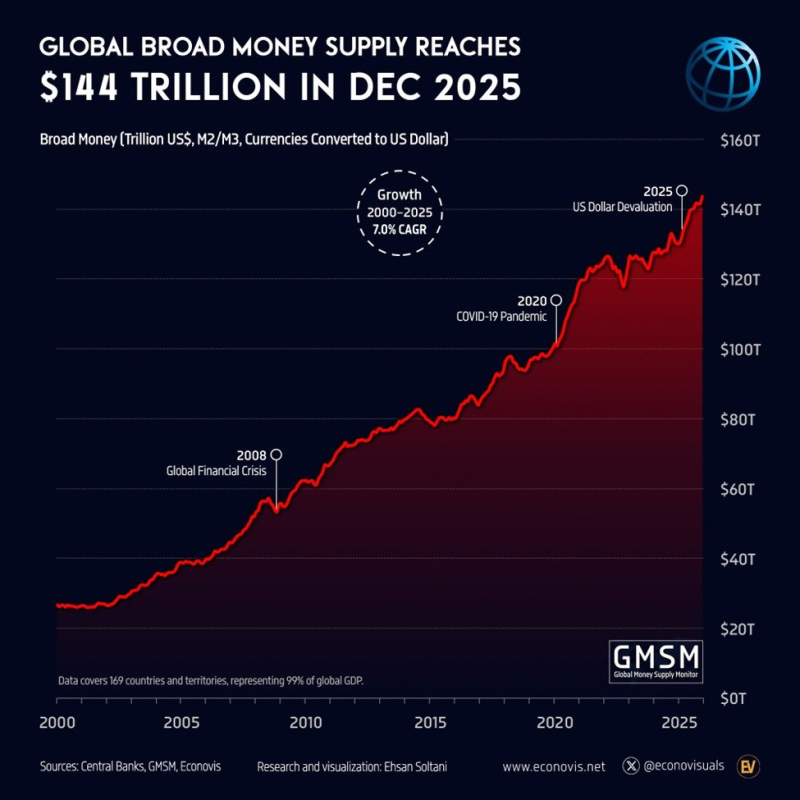
To put the current number in context, global broad money supply has grown by roughly $118 trillion since 2000 - a compounded annual growth rate of about 7.0% over 25 years. That's a steady, long-term expansion, but the post-pandemic surge stands apart. Since 2020, global money supply has risen by $44 trillion, or 44%, in just five years. The fastest single reading in that period came in February 2021, when annual growth hit 18.7% - a pace rarely seen outside full-blown crisis conditions.
Global money creation has rarely moved at such a pace outside crisis conditions. - The Kobeissi Letter
The 2008 financial crisis and the pandemic both left visible marks on the long-term chart, each triggering sharp liquidity inflections that took years to normalize. The late-2025 acceleration is being read by some analysts as a similar macro signal - not routine monthly noise, but a structural shift worth tracking.
Why the $144T Record Matters for Markets in 2026
Broad money supply doesn't move markets in isolation, but it sets the backdrop. When global liquidity expands at this pace, it typically shapes risk appetite, currency dynamics, and volatility regimes across asset classes. The question now is where that liquidity flows - into credit creation, bank deposits, or speculative positioning.
For a closer look at how liquidity trends are playing out across different markets, see related coverage on TheTradable: Global Cash Pile Jumps 18.6% in 2026 as $119T Liquidity Hits New Highs. On the U.S. side, U.S. M2 Money Supply Reaches Record $22.2 Trillion shows how domestic money creation fits into the global picture. And for what this means for equities, S&P 500 Gap vs M2 Hits Record 270% as U.S. Stocks Outrun Liquidity breaks down the growing disconnect between stock valuations and the money supply driving them.
 Saad Ullah