Saad Ullah

In the past many individuals who buy assets viewed helium as a secondary material that is useful for medical imaging devices and industrial tools - but the expansion of systems for artificial intelligence is altering how participants in the market evaluate this gas.
By looking at every large project for artificial intelligence, one sees a physical network of computer chips, systems that lower temperatures, power grids and materials for industry. Helium is a part of almost all those components. And because this material differs from other substances used in technology, its global production stays in the hands of a few providers and relies on transport paths that are easily disrupted.
With this set of factors, helium is moving from a neglected industrial resource to a source of political tension between nations.
The Commodity Nobody Was Watching
For a long time helium was a minor part of the world economy that was not easy to see or likely to cause disagreement. It was associated with decorative balloons and medical scanners in public thought. On the markets people focused on petroleum. By contrast governments focused on computer chips. At the same time investors monitored metals like lithium and copper.
Then infrastructure for artificial intelligence was developed. Because of this change, a specific gas used in industry became important for national strategy.
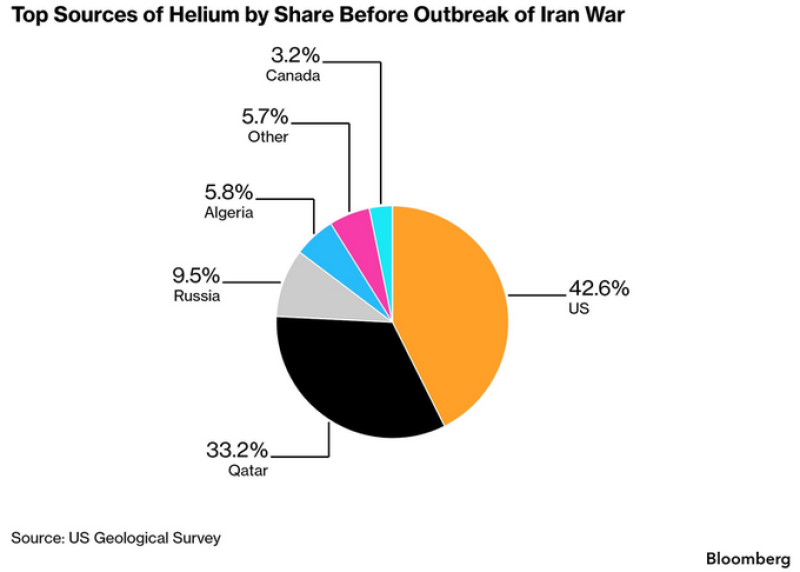
As shown by records collected before the start of the conflict involving Iran, the United States produced 42.6% of the global helium supply. For its part Qatar produced 33.2%. Russia provided 9.5%, Algeria provided 5.8% & Canada provided 3.2%. In effect two nations had control over more than 75 % of the global market.
To see the concentration more clearly, one must look at data over multiple years. By examining records from the U.S. Geological Survey, global helium output grew from about 158 million cubic meters in 2022 to approximately 180 million cubic meters in During this time, Qatar increased its output. In 2025 Qatar was the second largest producer of helium after the United States - this shows that global supply chains are dependent on the transport networks in the Gulf.
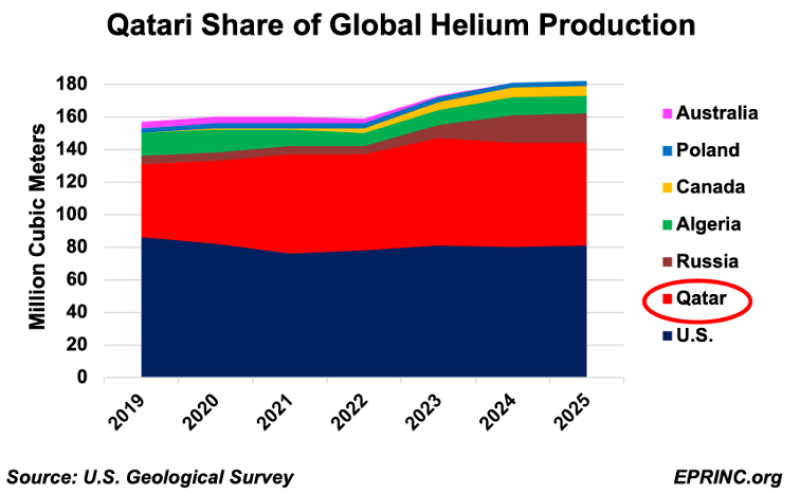
The market appears to have many sources only until a period of high demand or low supply occurs.
A Supply Chain Built Around Fragile Geography
Because helium is difficult to keep in containers and expensive to move, its markets are always restricted. It is usually a secondary product from the extraction of natural gas. When supply stops, it does not act like other materials where companies can quickly produce more. If transport paths are not stable, the lack of gas can last for a long time.
This is where the relationships between countries become important.
By design the export of helium from Qatar is connected to the same shipping systems that move liquid natural gas. If there is instability in the shipping lanes of the Middle East, there is pressure on oil prices and a risk to the export of gases used for making chips, building aircraft and medical tools.
To compare it to the oil market, helium has very little extra supply available. If a disruption begins in industrial supply chains, it is difficult to manage.
Why AI Infrastructure Changes the Equation
For the era of artificial intelligence, helium is important because modern computers require industrial processes that do not change. In the manufacturing of semiconductors, workers use helium for cooling and in environments where temperature control is necessary. At the same time large technology companies are building more data centers to train artificial intelligence models and provide cloud services.
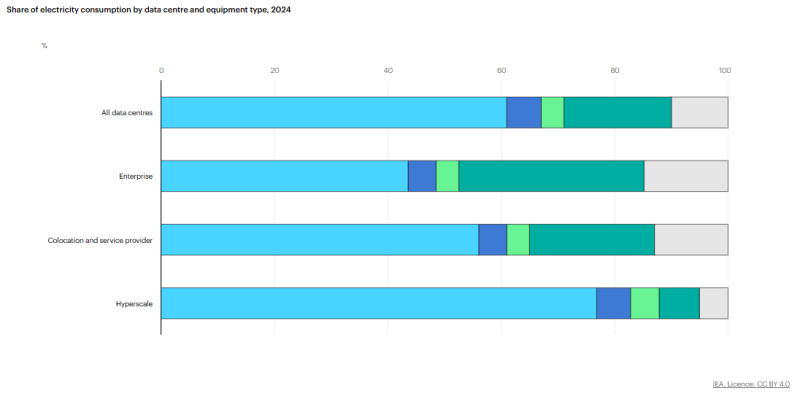
On the basis of data from the International Energy Agency in 2024, very large facilities now use the most electricity among modern data centers. Small data centers for businesses use a much lower amount of power. By contrast the growth in global power systems is driven by the large facilities.
And the trend for electricity use moves in the same direction. By the end of the decade, the International Energy Agency expects global electricity use to grow by 3 % to 4 % each year. In regions where industry and artificial intelligence are growing, like the United States besides Southeast Asia, this growth is expected to be highest.
If this is true it is because the economy for artificial intelligence is about more than just processing units. It is a situation involving physical systems like power grids, cooling methods and industrial gases.
As markets already recognize the value of chips and rare minerals, helium is likely to be the next part of infrastructure that investors begin to value differently.
The Next Invisible Supply Shock
With helium there is almost no popular story about its value yet. There is no high level of buying by the public. There are no long talks about a “helium supercycle”. The market treats it as a minor gas for industry rather than a resource for important infrastructure.
But artificial intelligence often makes hidden supply chains become significant very quickly.
By observing the last few years, one sees that investors had to change their views on electricity, nuclear energy and copper because of artificial intelligence. Helium is now in this same group. It is important because modern technology is dependent on components that are not always visible.
 Saad Ullah