Artem Voloskovets
It was too large to ignore, too controversial to fully integrate, and too legally uncertain for many institutions to touch comfortably. Even during periods when Bitcoin and Ethereum moved deeper into the financial mainstream, XRP often remained trapped inside an unresolved question: what exactly is it in the eyes of the U.S. regulatory system?
The document circulating this week around the proposed “Clarity Act” hints at something larger than another crypto policy debate.
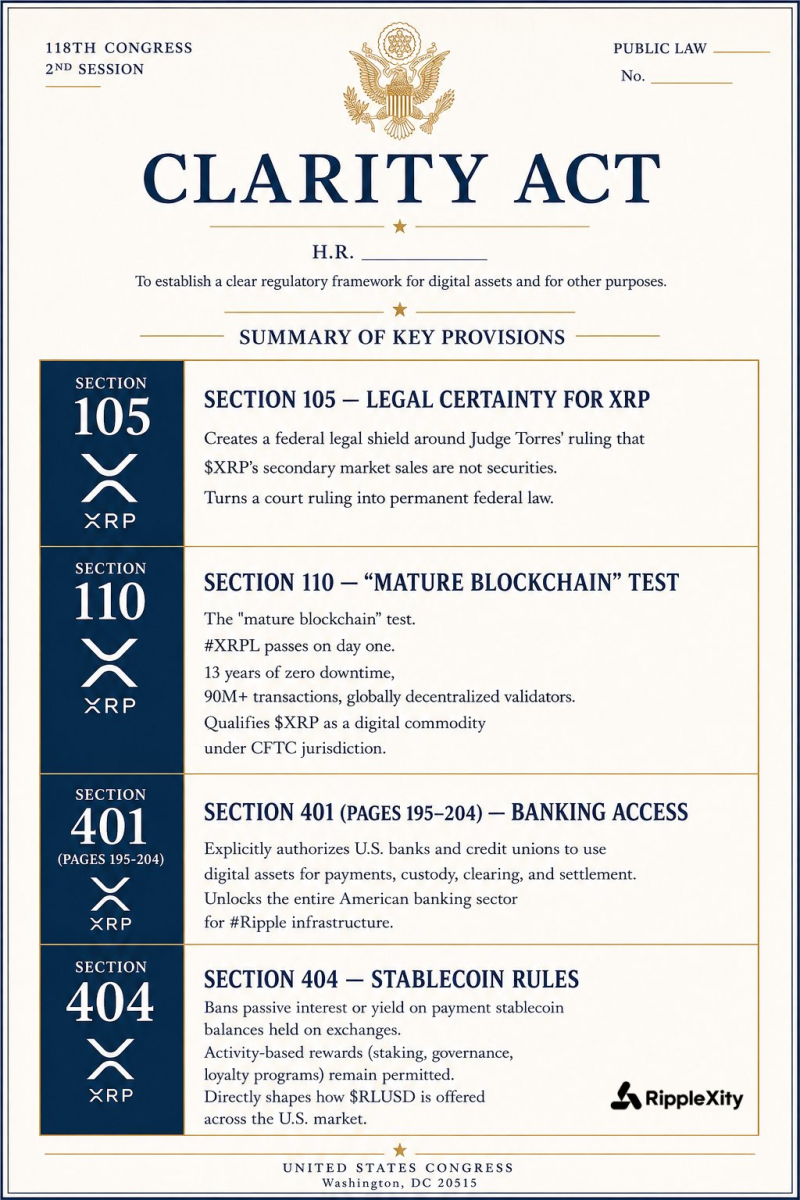
The circulating “Clarity Act” summary reframes XRP less as a speculative asset and more as financial infrastructure.
That is a major difference.
For most of the past four years, XRP’s identity was defined by conflict with the SEC. Markets priced the asset accordingly. Exchanges treated it cautiously. Institutions approached it conditionally. The asset existed in a permanent regulatory gray zone where adoption was theoretically possible but operationally uncomfortable.
The image attached to the proposed framework suggests an attempt to remove that ambiguity directly.
Several sections stand out not because they are dramatic, but because they normalize XRP inside existing financial architecture.
| Section | Why It Matters |
| Section 105 | Reinforces legal distinction around XRP secondary sales |
| Section 110 | Frames XRP as a “mature blockchain” rather than speculative token |
| Section 401 | Suggests broader banking access for blockchain settlement infrastructure |
| Section 404 | Clarifies stablecoin-related operational rules |
Section 105 effectively codifies Judge Torres’ ruling into federal legal structure, reinforcing the distinction between XRP itself and the manner in which it may be sold. That alone matters because institutions generally avoid assets whose legal treatment can change retroactively through enforcement.
But the more important shift may be conceptual rather than legal.
The document repeatedly frames XRP not as a speculative crypto asset, but as part of transactional infrastructure: payments, custody, clearing, settlement, banking access. In other words, the language starts resembling financial plumbing rather than crypto marketing.
That subtle repositioning could matter more over time than short-term price reactions.
Crypto markets still tend to value assets through narratives inherited from the retail era: community size, ETF speculation, scarcity models, meme velocity. Yet regulatory frameworks increasingly care about something else entirely - operational function.
Bitcoin became institutionally acceptable partly because regulators and markets eventually converged on a relatively stable identity for it: a commodity-like store of value. Ethereum evolved into programmable infrastructure. XRP, by contrast, spent years existing between categories.
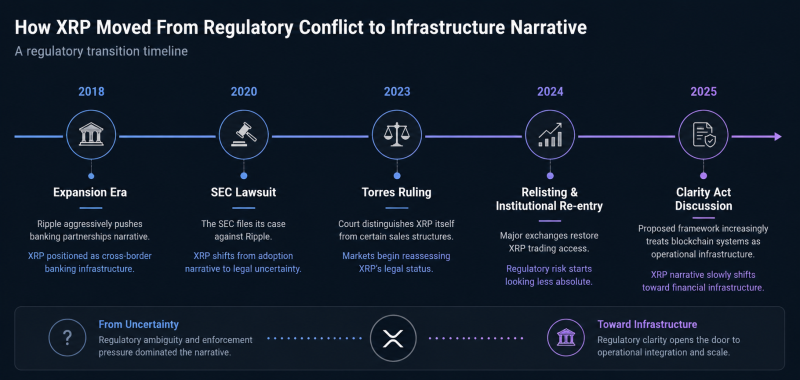
How XRP moved from regulatory uncertainty toward infrastructure positioning.
The “mature blockchain” framing inside the document attempts to resolve that ambiguity by emphasizing longevity, uptime, transaction history, and decentralization metrics rather than ideological crypto language.
That is not accidental.
Washington appears to be slowly developing a distinction between speculative tokens and digital infrastructure systems. Whether that framework ultimately succeeds remains uncertain, but the direction itself matters. Assets that survive long enough often stop being evaluated purely as trades and start being evaluated as systems.
Why This Feels Different From Previous XRP Cycles
Earlier XRP cycles were driven mostly by speculation around partnerships, exchange relistings, or court developments. The difference now is that the conversation is slowly shifting toward operational legitimacy.
Markets can price hype quickly. Infrastructure recognition takes longer - but tends to matter more over time. The most interesting section may actually be the banking access language.
If traditional U.S. financial institutions are eventually given clearer authorization to interact with blockchain-based assets for settlement and custody, the conversation around XRP changes materially. Not because banks suddenly “adopt XRP overnight” - crypto narratives often exaggerate institutional speed, but because legal uncertainty stops acting as a structural deterrent.
Infrastructure rarely scales explosively at first. It becomes integrated gradually, then quietly unavoidable.
That dynamic already happened with cloud computing, APIs, and stablecoins themselves. The systems that ultimately matter often look unexciting during the transition period because markets are still searching for the old speculative narrative while the real story shifts underneath.
Markets spent years asking whether XRP could survive regulation. The next phase may revolve around whether regulation quietly makes XRP usable.
Ironically, XRP may now face the opposite problem from the one it had during the SEC era. The asset received attention because of regulatory conflict. If regulatory normalization actually arrives, XRP becomes less controversial - and potentially more useful.
Those are not always the same trade.
If that transition is real, XRP may gradually stop behaving like a perpetual regulatory trade and start behaving more like financial infrastructure. Markets are usually slower at recognizing the second category - partly because infrastructure stories are less exciting while they are forming.
 Artem Voloskovets