Usman Salis

Global appetite for U.S. markets hit an all-time high last year. Non-U.S. investors purchased a net $1.55 trillion of American financial assets in 2025, surpassing 2024's $1.18 trillion by 31%. According to data highlighted by The Kobeissi Letter, inflows were positive in every single month except April, making 2025 one of the most consistent years of foreign capital accumulation in U.S. market history.
Equities and Treasuries Drove $1.13T of the Total Inflows
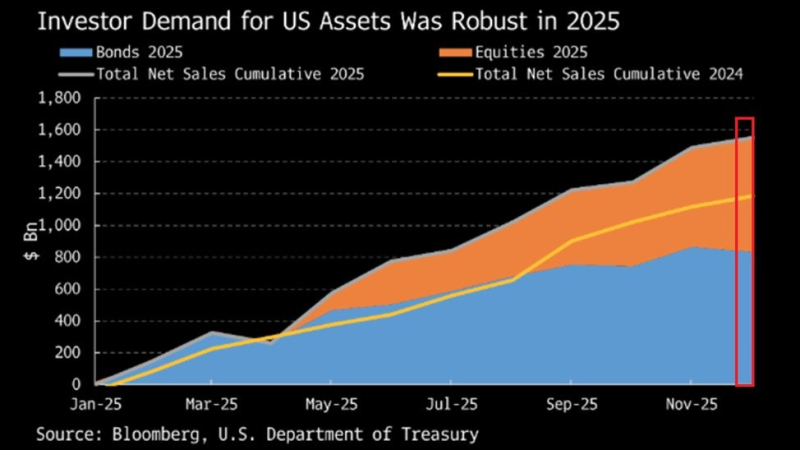
The bulk of the buying was split between two major asset classes. Net equity purchases reached $720 billion, while Treasury notes and bonds attracted another $409 billion, together accounting for roughly $1.13 trillion of the $1.55 trillion total. That combination signals broad-based demand, not just a flight to safety or a pure risk-on move, but both at once, which is fairly unusual.
U.S. assets saw net inflows in every month of 2025 except April. - The Kobeissi Letter
Europe was the biggest source of capital, contributing $873 billion in net inflows. The Cayman Islands followed at $277 billion, Canada at $84 billion, and Japan at $56 billion. For more on Japan's outsized exposure, see Japanese Investors Hold $2.22T in US Assets, Far Outpacing Other Markets.
China Cut Its Treasury Holdings to the Lowest Level Since 2008
Not everyone was buying. China stood out as a net seller, offloading $209 billion in U.S. assets during the year. Its Treasury holdings ended 2025 at $684 billion, the lowest level since 2008. That shift has real market implications, and TheTradable has covered the broader story in depth: China Slashes $683B in U.S. Treasury Holdings: Markets Face New Volatility.
Meanwhile, European investors picked up much of that slack, reinforcing a geographic rebalancing in who holds U.S. paper. For context on how investment flows compare across regions, US Leads EU Investment While Luxembourg Dominates Direct Flows offers a useful breakdown.
The scale and consistency of 2025 inflows confirm that U.S. equities and Treasuries remain the default destination for global capital, even as geopolitical tensions reshape who exactly is doing the buying.
 Usman Salis