Usman Salis
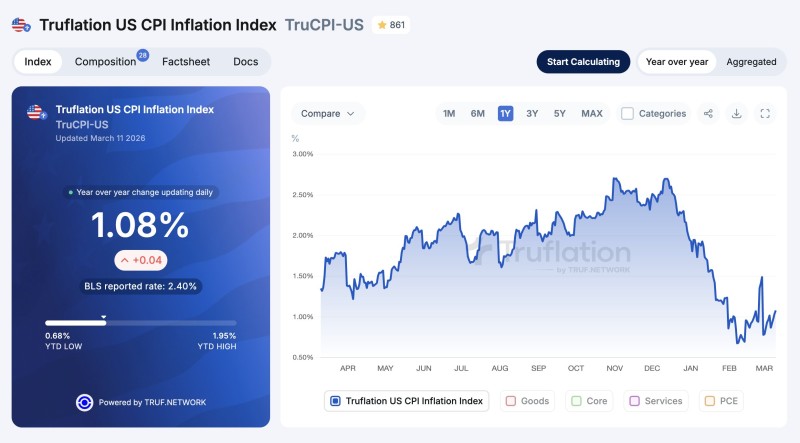
While official government data places U.S. inflation at 2.4%, an alternative real-time tracker is telling a very different story. The Truflation US CPI Inflation Index currently shows annual price growth at just 1.08% gap wide enough to raise serious questions about how inflation is actually measured, and what that means for monetary policy going forward.
Real-Time Data vs. Official CPI: A 1.32% Gap
The Truflation platform pulls continuously updated price data across dozens of economic categories, generating a daily inflation reading rather than a monthly snapshot. Its latest figure of 1.08% compares sharply against the BLS January CPI of 2.4% divergence of more than 130 basis points. The Bureau of Labor Statistics releases its Consumer Price Index once a month, often reflecting price conditions that are weeks old by the time they reach the public. Real-time trackers like Truflation aim to close that lag, offering a more current view of where prices actually stand.
February BLS CPI Projection Sits Near 2.4%
Despite the low real-time reading, Truflation's regression models estimate that the upcoming February BLS CPI release will land near 2.4% - squarely in the middle of the market consensus range of roughly 2.3% to 2.5%. This projection reflects the structural differences between how each index is built, not necessarily an error in either methodology. Earlier Truflation data flagged inflation cooling to 0.98% before official figures acknowledged a similar trend, suggesting the platform tends to lead BLS data on turning points.
The growing divergence between the two systems has become a recurring theme in macro discussions. At one point, the gap reached 200 basis points with Truflation showing 0.68% while official CPI sat near 2.7%. While central banks and policymakers continue to rely on official CPI as their primary benchmark, the rise of real-time alternatives is reshaping how analysts and traders interpret inflation signals. As markets brace for the next BLS release, the contrast between these two data streams is unlikely to fade anytime soon.
 Usman Salis