Marina Lyubimova
The UAE economy expanded 6.2% in 2025, reaching nearly AED 1.9 trillion ($517 billion), according to data released by the Federal Competitiveness and Statistics Centre and reported by state media. At first glance, the number is simply another strong growth figure from one of the Middle East's most dynamic economies. A closer look, however, suggests something more significant is happening.
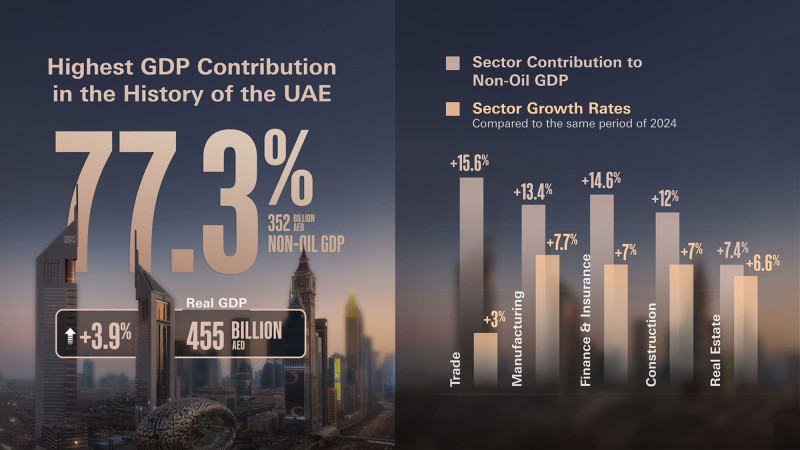
Non-oil GDP grew 6.8% during the year, reaching approximately AED 1.5 trillion and accounting for nearly 80% of total economic output. That marks another step in the country's long-running effort to reduce its reliance on hydrocarbons and build growth around trade, finance, manufacturing, tourism, and technology.
Non-Oil Economy Approaches 80% of GDP
The scale of the shift is difficult to ignore. Just a decade ago, oil revenues played a far larger role in driving economic activity across the UAE. Today, nearly four out of every five dirhams generated by the economy come from non-oil sectors.
The latest figures imply that the UAE added roughly AED 124 billion ($34 billion) in real economic output over the past year alone, with most of that increase coming from activities outside the energy sector.
The data highlights how the country's economic model has evolved from one centered primarily on natural resources into a broader platform for international trade, investment, logistics, and financial services.
Finance Is Emerging as a Key Growth Driver
The composition of non-oil growth may be even more important than the headline GDP number. Official sector data shows that trade remains the largest contributor to non-oil GDP with a 16.1% share. Manufacturing follows at 13.9%, while finance and insurance contribute 13.5%. Construction accounts for 11.9%, with real estate representing 7.9%.
However, the fastest growth is no longer coming from trade. During the first nine months of 2025, finance and insurance expanded 9% year-over-year, outperforming construction (8.7%), real estate (7.9%), and manufacturing (6.9%).
Major Non-Oil Sectors in the UAE Economy
| Sector | Share of Non-Oil GDP | Growth Rate |
| Trade | 16.1% | 3.0% |
| Manufacturing | 13.9% | 6.9% |
| Finance & Insurance | 13.5% | 9.0% |
| Construction | 11.9% | 8.7% |
| Real Estate | 7.9% | 7.9% |
Source: Federal Competitiveness and Statistics Centre (FCSC)
Trade remains the largest contributor to non-oil GDP, while finance and insurance recorded the fastest growth among major sectors.
The table highlights a shift that is easy to miss in the headline GDP data. Trade remains the largest non-oil sector, but its growth has slowed to 3%. Meanwhile, finance and insurance are expanding three times faster. The gap suggests that future economic growth may increasingly come from banking, wealth management, investment activity, and capital markets rather than traditional trade flows alone.
That trend supports the UAE's broader ambition to position Dubai and Abu Dhabi among the world's leading financial centers. As global banks, investment firms, hedge funds, and family offices continue expanding their regional presence, financial services are becoming a more important contributor to incremental GDP growth.
Why Investors Are Paying Attention
The UAE's growth rate stands out in an environment where many developed economies are expanding far more slowly.
Beyond the headline number, investors are watching the country because of its ability to attract capital, businesses, and talent simultaneously. Low taxes, business-friendly regulations, world-class infrastructure, and strategic access to markets across Europe, Asia, and Africa continue to strengthen its appeal.
Those inflows create a reinforcing cycle. New companies bring investment, investment attracts skilled workers, and population growth supports demand across housing, finance, transportation, and consumer sectors. The result is an economy that is becoming increasingly driven by private-sector activity rather than commodity cycles.

The Next Phase of Growth
Oil remains an important source of government revenue and strategic investment capital. Yet the latest GDP figures show that hydrocarbons are no longer the primary story behind the UAE's economic expansion.
The strongest growth is increasingly coming from sectors tied to commerce, finance, manufacturing, and investment flows. That distinction matters because economies built around multiple growth engines tend to be more resilient than those dependent on a single commodity. The UAE's latest numbers suggest that diversification is no longer an ambition or policy objective - it is becoming visible in the country's economic data.
The 6.2% growth figure is impressive on its own. More importantly, it reveals how quickly the foundations of the UAE economy are changing.
 Marina Lyubimova