Marina Lyubimova
If you've been watching inflation headlines lately, you may have noticed a growing disconnect between what official statistics say and what real-time data shows. As of February 25, 2026, Truflation's U.S. CPI reading stands at 0.94% year-over-year - a figure that's dramatically lower than the 2.40% reported by the Bureau of Labor Statistics. Goods inflation is tracking at 1.14%, while services inflation sits at 0.84%, both pointing to noticeably subdued price pressures heading into late February.
How Tariffs Added 0.8% to CPI — and Why That Effect Is Now Fading
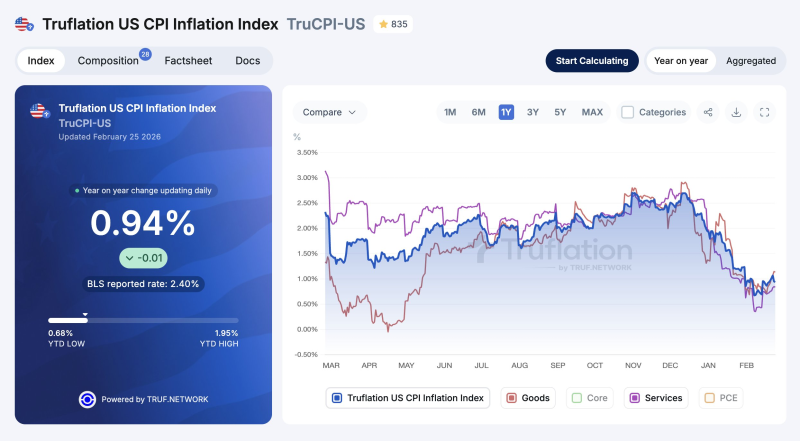
The story behind the numbers goes back to April 2025, when fresh tariff announcements sent goods prices climbing. That upward pressure persisted through the rest of the year, with Truflation estimating that cumulative goods price pass-through added roughly 0.8 percentage points to its CPI reading by November 2025. Without that tariff effect, inflation that month could have sat closer to 1.5%. Since December 2025, however, goods prices have started easing — and the narrowing gap between goods and services inflation suggests the tariff impact has now been largely digested by the market.
The decreasing gap between goods inflation and services inflation suggests the tariff impact has now been absorbed into prices. - Truflation, February 2026
Services inflation, meanwhile, has stayed lower than it was earlier in 2025, reinforcing the broader picture of cooling price pressures. The gap between alternative trackers and official BLS data has been widening for months, fueling debate about which measures more accurately capture what consumers are actually experiencing.
Real-Time vs. Official Data: Why the 1.46% Gap Matters for Policy
The 1.46 percentage point difference between Truflation's 0.94% and the BLS's 2.40% isn't just a statistical curiosity - it has real implications for how policymakers, investors, and economists interpret inflation trends. Traditional government measures rely on periodically sampled survey data, while real-time indexes like Truflation draw from millions of actual price observations across product and service categories, updated continuously.
Earlier this month, Truflation briefly recorded a reading as low as 0.86% - the lowest since 2020 - signaling that disinflationary momentum remains intact. As these persistent gaps between real-time and official measures grow harder to ignore, the conversation around inflation monitoring tools and policy timing is only going to get louder.
 Marina Lyubimova