Usman Salis
The Truflation US CPI Inflation Index climbed to 1.21% year over year as of March 12, 2026, posting a daily gain of 0.13 percentage points. While the reading signals a modest uptick in price pressures, it still sits well below the Federal Reserve's long-term 2% target. Rising geopolitical tensions, including the ongoing conflict involving Iran, are injecting fresh uncertainty into energy and commodity markets, adding short-term inflationary risk that global investors are watching closely.
Real-Time Data Shows a 1.19% Gap Below Official CPI
One of the most telling aspects of the latest update is the gap between real-time and official data.
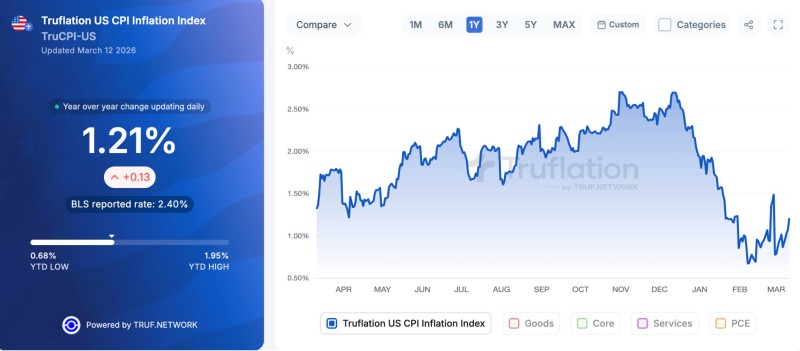
The Bureau of Labor Statistics currently reports CPI at around 2.40%, while Truflation sits at 1.21% — a difference of more than a percentage point. This divergence has been consistent.
Alternative inflation data often signals price trends earlier than official statistics — and the gap between the two can tell you more than either number alone.
As noted in Truflation US CPI Shows Inflation at 0.86% — Well Below the Official 2.40%, alternative trackers tend to capture price shifts earlier than official monthly reports, making them a valuable signal for traders and analysts.
Index Ranges From 0.68% to 1.95% Year to Date
Over the past year, the Truflation index has traded within a relatively narrow band, touching a year-to-date low of 0.68% and a high near 1.95%. That range reflects a broader cooling in price pressures compared to previous inflation cycles. A similar trend was highlighted in US CPI at 0.94%: Truflation Data Shows Inflation Cooling Well Below the Official 2.40% BLS Rate, where analysts pointed to declining inflation across goods and services categories.
Still, the picture is not entirely stable. Geopolitical disruptions can push energy prices higher quickly, creating temporary spikes that ripple through broader inflation indexes. As explored in US Inflation Plunges to 1.18% as Real-Time Data Reveals Sharp Cooling, daily data feeds offer a faster view of these shifting dynamics than traditional reporting cycles allow. Bitcoin and broader financial markets continue to track real-time inflation indicators closely, as inflation expectations remain a key driver of monetary policy outlook and market sentiment.
 Usman Salis