Alex Dudov
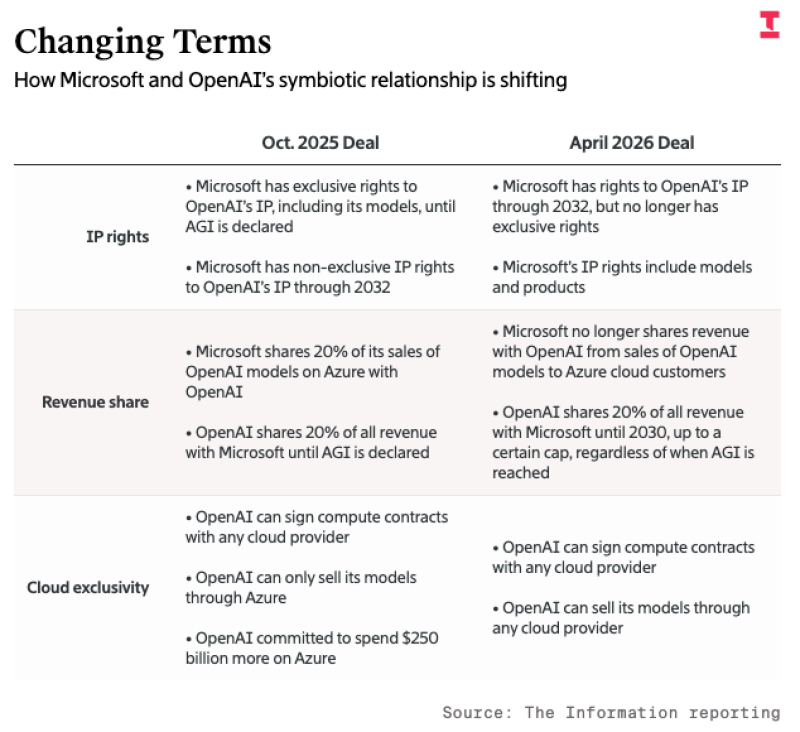
At first glance, the updated April 2026 agreement still keeps Microsoft deeply tied to OpenAI’s ecosystem. But the side-by-side comparison with the original October 2025 arrangement reveals something much bigger: OpenAI is steadily reducing Microsoft’s long-term control over its business, infrastructure, and future AI commercialization strategy.
The most important change may involve exclusivity.
Under the earlier agreement, Microsoft effectively held exclusive rights to OpenAI’s intellectual property until AGI was declared, while OpenAI could only distribute its models through Azure. The new deal dramatically weakens those restrictions. OpenAI can now sell models through any cloud provider and sign compute agreements freely across the industry.
That shift could reshape competitive dynamics across the AI infrastructure market.
For years, Microsoft’s partnership with OpenAI helped position Azure as the primary commercial gateway for frontier AI models. But the revised structure suggests OpenAI is increasingly prioritizing independence over platform exclusivity - a move that may eventually benefit cloud rivals including Amazon Web Services and Google Cloud.
The revenue structure is also changing.
Read more:

Microsoft will reportedly no longer share revenue from OpenAI model sales on Azure customers, while OpenAI’s revenue-sharing obligations with Microsoft are now capped through 2030 regardless of whether AGI is reached. That removes one of the most unusual variables in the original partnership: the open-ended economic implications tied to AGI milestones.
The broader trend is becoming clearer across the AI industry.
As frontier model developers grow larger and more commercially powerful, they appear increasingly unwilling to remain tightly controlled by hyperscale cloud partners that originally financed their expansion. OpenAI’s evolving agreement with Microsoft may therefore represent more than a contract update - it could signal the gradual transition from dependency to strategic separation.
Despite the changes, Microsoft still retains important rights to OpenAI’s IP through 2032. But the latest terms suggest the balance of leverage inside one of AI’s most important partnerships is no longer moving in only one direction.
 Alex Dudov