Marina Lyubimova

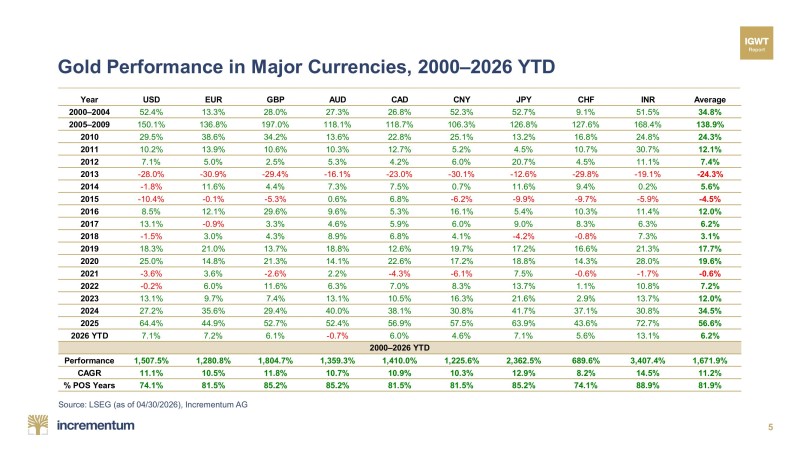
According to the chart, gold has appreciated more than 1,500% against the U.S. dollar, over 1,800% against the British pound, and more than 2,300% against the Japanese yen during the period.
The data tracks yearly gold performance across USD, EUR, GBP, AUD, CAD, CNY, JPY, CHF, and INR from 2000 through 2026 YTD - revealing a remarkably consistent long-term uptrend against fiat currencies worldwide.
Gold’s Long-Term Trend Is Becoming Harder to Ignore
While gold often receives less media attention than Bitcoin, AI stocks, or high-growth tech names, the longer-term data continues telling a very different story. The chart shows that gold delivered positive annual returns in roughly 74%–89% of years depending on the currency measured.
Against the Indian rupee, gold surged more than 3,400% since 2000. Against the Japanese yen, gains exceeded 2,360%, while the compound annual growth rate approached 13%. Even versus traditionally stable currencies such as the Swiss franc, gold still appreciated nearly 690% over the period.
For macro investors, those numbers reinforce an increasingly popular thesis:
Gold is behaving less like a commodity and more like a parallel monetary asset.
2025 Became a Major Breakout Year
One of the most striking sections of the table is the 2025 performance row. Gold gained:
- 64.4% against USD,
- 57.5% against CNY,
- 63.9% against JPY,
- and 72.7% against INR.
Those moves came during a period marked by persistent global debt concerns, geopolitical instability, weakening confidence in sovereign bonds, and accelerating central bank demand for hard assets.
The rally also coincided with continued reserve diversification efforts among emerging economies seeking to reduce long-term dependence on the U.S. dollar system.
Why Macro Investors Are Watching Gold Again
Unlike speculative momentum assets, gold’s recent resurgence appears increasingly tied to structural positioning rather than short-term hype. Institutional allocators are now watching several overlapping trends:
- rising sovereign debt levels,
- sticky inflation risks,
- weakening purchasing power across fiat currencies,
- and record central bank gold accumulation.
That combination is bringing gold back into focus not just as a defensive hedge, but as a strategic reserve asset in an increasingly fragmented financial system.
For niche macro traders and commodity-focused investors, the chart serves as a reminder that while newer narratives dominate headlines, one of the oldest monetary assets in history continues quietly compounding against fiat currencies almost everywhere in the world.
 Marina Lyubimova