Alex Dudov

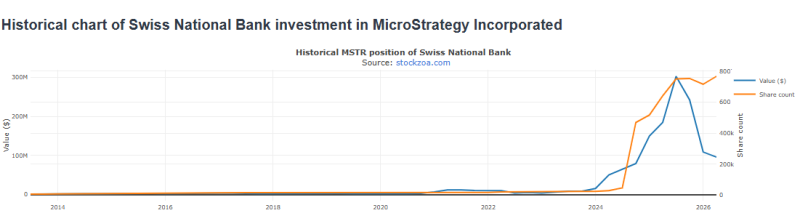
According to recent market discussions and public holdings data, the Swiss National Bank increased its position in Strategy ($MSTR), adding roughly $10 million worth of shares.
For traditional investors, $10 million may not sound enormous. But for Switzerland - a country known for cautious monetary policy, conservative banking culture, and institutional discipline - the symbolic value could be far bigger than the size of the position itself. And that is exactly why the market is paying attention.
Why MSTR Matters More Than a Stock
Strategy is no longer viewed by many investors as a standard software company.
Under the leadership of Michael Saylor, the company transformed itself into one of the largest corporate holders of Bitcoin in the world. As a result, MSTR has increasingly become a synthetic Bitcoin vehicle for institutions that may prefer equity exposure over direct crypto custody.
That distinction matters for central banks, pension funds, sovereign entities, and regulated institutions. Buying Bitcoin directly can still involve operational, legal, and political complications. Buying a publicly traded company listed on U.S. markets is far easier.
The Swiss move fits into a broader institutional trend that has quietly accelerated over the last year.
Conservative Capital Is Moving Toward Bitcoin
The narrative is no longer driven only by crypto-native funds or retail traders. Traditional financial powerhouses are entering the market through multiple channels:
- Vanguard reportedly accumulated hundreds of millions in MSTR exposure.
- The Czech Republic has openly explored direct Bitcoin reserve strategies.
- Luxembourg has also been linked to growing institutional Bitcoin allocation discussions.
- Spot Bitcoin ETFs continue attracting billions in inflows from traditional finance.
Taken together, the pattern is becoming difficult for markets to ignore. The institutions historically associated with stability, reserve preservation, and low-risk capital allocation are increasingly seeking exposure to Bitcoin - directly or indirectly.
The Scarcity Narrative Is Returning
The renewed attention toward Bitcoin comes as investors revisit one of the asset’s core properties: fixed supply. There will only ever be 21 million BTC. That number has always been central to Bitcoin’s investment thesis, but the conversation changes dramatically once sovereign entities, central banks, and large institutional allocators begin competing for exposure.
For years, Bitcoin adoption was framed as speculative enthusiasm from technology investors and retail traders. Now the narrative is shifting toward strategic accumulation. And if more central banks begin viewing Bitcoin as a geopolitical reserve asset, even small allocations could have an outsized impact on available supply.
Why the Market Is Watching Switzerland Closely
Switzerland carries unusual weight in global finance. The country’s reputation for monetary discipline and banking conservatism means its investment behavior is often interpreted as a signal rather than simple portfolio diversification.
That is why even a relatively small increase in MSTR exposure is fueling broader speculation across crypto markets. Importantly, the chart of Swiss National Bank holdings suggests this was not a one-time trade, but part of a longer-term positioning trend that accelerated alongside institutional Bitcoin adoption in 2024 and 2025.
Investors increasingly believe that institutional adoption is moving beyond hedge funds and ETFs into the realm of sovereign and quasi-sovereign accumulation. Whether Switzerland expands its exposure or not, the broader trend appears intact:
Traditional finance is no longer asking whether Bitcoin belongs in institutional portfolios.
It is now deciding how much exposure is enough before the next phase of adoption begins.
 Alex Dudov