Marina Lyubimova

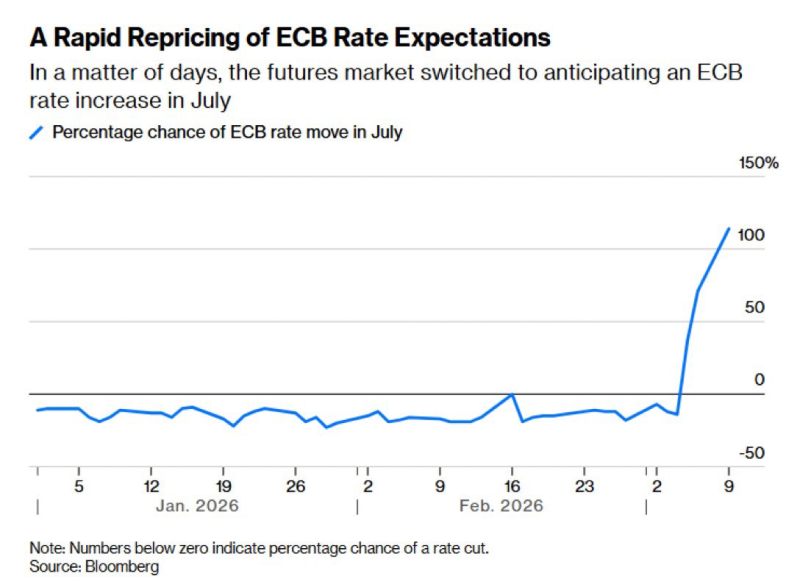
Something has shifted fast in eurozone rate markets. After months of subdued expectations, traders have abruptly repriced the outlook for European Central Bank policy, now placing a meaningful probability on a rate hike as early as July 2026. The trigger is familiar: Europe's unresolved energy shock continues to drive inflation higher and squeeze industrial output, forcing markets to revisit assumptions that had kept ECB tightening off the table.
From Neutral to Hawkish: How Fast Did Futures Move?
For most of January and February 2026, futures pricing pointed to little chance of an ECB hike, with probabilities hovering near neutral. Then, within just days, implied expectations surged dramatically.
Europe continues to face a severe economic challenge linked to energy policy and the latest energy shock affecting industrial activity and inflation.
That kind of abrupt repricing usually signals a rapid reassessment of inflation risks, one where traders stop giving policymakers the benefit of the doubt and start positioning for action. As analyst Michael A. Arouet noted, Europe's energy policy has created a structural vulnerability that keeps reasserting itself in the inflation data.
The backdrop for this shift is uneven but unmistakable. According to Euro Area Inflation Rises to 1.9% in February 2026, Flash Estimate, inflation moved back toward the ECB's target in February, keeping policymakers on alert. But the picture is far from uniform across the bloc.
Uneven Inflation Across the Bloc Complicates the ECB's Next Move
Earlier data covered in Euro Area Inflation Slows to 1.7% in January 2026, With Romania Leading at 8.5% revealed just how fragmented conditions remain, with some member states running inflation five times higher than others. That divergence makes any blanket rate decision politically and economically fraught for the ECB.
The broader market implications are real. When traders reprice central bank expectations this sharply, the effects ripple outward fast, hitting government bond yields, equity valuations, and the euro. The debate, outlined clearly in Eurozone Inflation Hits 2% - Rate Cuts Next or Core Pressure Ahead?, now cuts both ways: are we seeing a one-off energy spike, or is core inflation sticky enough to force the ECB's hand? July may provide the answer.
 Marina Lyubimova