Alex Dudov

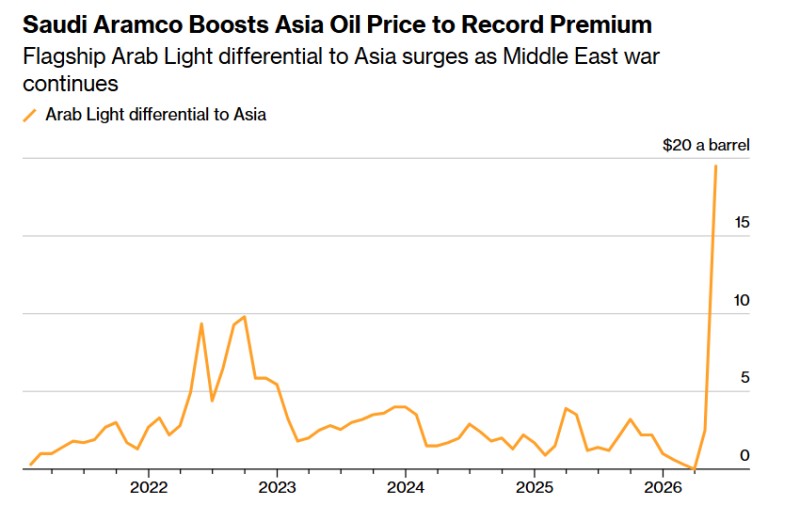
Crude oil pricing has shifted into territory it has never occupied before. Ted, who flagged the move on X, put the increase at roughly $19.5 a barrel - and the underlying chart makes the scale of that repricing impossible to dismiss. What had been a relatively contained differential for years has turned into a near-vertical surge toward $20, a level the market has simply never shown.
The market has moved from normal fluctuation into outright repricing, and that is why the inflation angle is now impossible to ignore.
The chart tracks the Arab Light differential to Asia from 2021 through most of 2026, moving within a modest band across that entire period. Even the strongest prior swings peaked well below where the line sits now. Then, abruptly, the structure changes. Instead of a gradual climb, the premium explodes almost straight up from near zero to around $20 a barrel. This is not a continuation of the old pattern - it is a complete break from it.
Oil Premium Structure Breaks Its Historic Ceiling
What makes the WTI, Brent Diverge as Asia Oil Prices Surge Above $150 backdrop particularly relevant here is the absence of any comparable peak in the Arab Light chart itself. Previous rallies in the premium pushed into single digits. This surge clears those highs by a wide margin.
When a market moves like this, the structure itself becomes the story.
That means the market is no longer reacting inside its old range. The earlier ceiling has been effectively invalidated, and the premium is now trading in a zone the chart has never shown. For analysts tracking crude flows, this is not a data point to smooth over - it is a signal that the pricing regime has changed.
Saudi Arabia's Oil Pricing Pushes Asia Toward Inflation Pressure
A record jump in Saudi Arabia's selling premium to Asia means higher crude costs are being pushed directly into one of the world's most important demand regions. The Oil Shock Warning: 1973 and 1979 Cycles Show Inflation Can Surge Far Beyond 2.7% parallel is worth keeping in mind: when oil pricing shocks have hit this fast before, inflation followed with a lag that caught markets off guard.
The chart does not show stabilization yet. It shows a shock move.
Until the premium either cools or forms a new range, the pricing pressure remains the dominant signal.
The setup at this stage is defined less by trend analysis than by scale. Importers across Asia - from South Korea to India to Japan - absorb these differentials directly into their refining economics. A sustained premium at this level feeds through to fuel costs, transport, and ultimately consumer prices across the region. As Oil Flows Fracture as Red Sea Risk Builds in 2024 outlined, disruptions to routing and pricing in this corridor tend to compound rather than resolve quickly.
Key dynamics now in focus:
- Arab Light differential has moved from near zero to roughly $20 a barrel
- No comparable peak exists in the 2021-2026 chart history
- Prior resistance levels have been invalidated, not tested
- Asia's inflation exposure increases with each week the premium holds
The inflation warning fits the chart's message precisely. Until the premium either cools or forms a new range at these elevated levels, the pricing pressure coming out of Riyadh remains the dominant signal for Asian energy markets.
 Alex Dudov