Artem Voloskovets

Global oil logistics are showing clear signs of stress as trade volumes through critical maritime chokepoints diverge sharply. The latest data highlights a sustained disruption in one of the world's most important shipping corridors - reinforcing concerns that supply chains are becoming increasingly fragile. Writing for X, Walter Bloomberg flagged that escalating Houthi threats to Red Sea shipping are raising the risk of higher oil prices, with analysts warning that deeper geopolitical escalation could push crude significantly higher.
Bab el-Mandeb vs. Hormuz: A Chart That Tells the Whole Story
The data shows a pronounced divergence between the Strait of Hormuz and the Bab el-Mandeb strait. While Hormuz volumes remain within a relatively stable range, Bab el-Mandeb flows experienced a sharp drop starting in early 2024 - directly tied to Houthi attacks on Red Sea shipping. Volumes fell from their prior range to a significantly lower level and have stayed there, forming a structural shift rather than a temporary fluctuation.
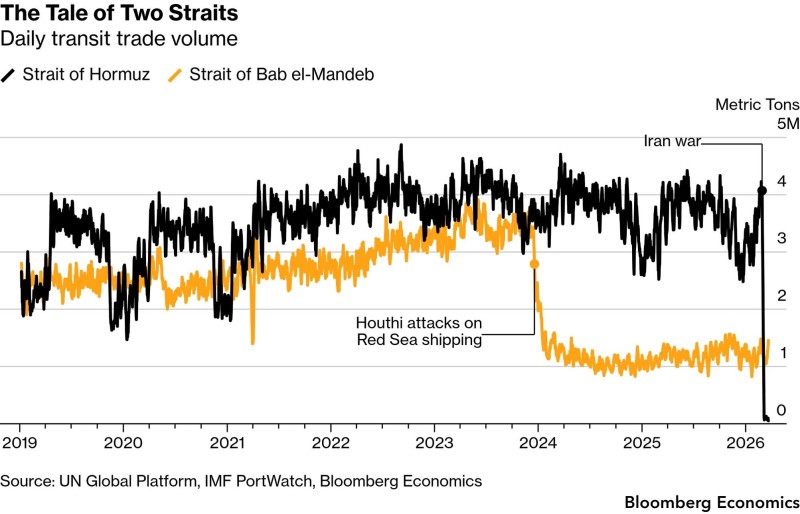
The persistence of reduced Red Sea volumes points to ongoing disruption rather than a short-term adjustment.
In contrast, the Strait of Hormuz continues to fluctuate within its established range without a comparable breakdown. This creates a visible imbalance in global oil transit:
- One route maintains relatively stable volumes
- The other has shifted into a sustained lower range
Red Sea Oil Disruption Signals a System Losing Flexibility
Before 2024, both transit routes moved within relatively stable ranges, offering balance across global shipping flows. That structure has now changed. Bab el-Mandeb traffic has stabilized at depressed levels with no clear recovery trend, while Hormuz shows no compensating expansion in throughput. The system is no longer balanced - it is constrained.
When a system is already operating with reduced redundancy, even incremental disruption can have an outsized impact on prices.
This setup aligns with broader oil market dynamics where disruptions in critical infrastructure tighten supply expectations - similar to the moves covered in WTI Crude Oil Falls 3.5% to $95 as Hormuz Tensions Ease.
How Geopolitical Risk Is Repricing Oil in 2024 and 2026
Recent market behavior reflects how geopolitical risks tied to key routes can influence oil pricing directly. That dynamic has been visible across multiple episodes, from the surge covered in WTI Oil Hits $114: Geopolitical Risks Trigger Biggest Surge Since 2022 to longer-term forecasts detailed in Brent Oil Outlook: Goldman Sees $115 as Inflation Risk Surges in 2026.
Oil prices are not yet reacting as if a full supply shock is underway - but the structure of global transit flows suggests that resilience is weakening fast.
Oil markets are not fully pricing in a supply shock yet, but the underlying flow data tells a quieter and more troubling story. With one of the world's key oil corridors stuck at compressed volumes and no offsetting expansion elsewhere, the buffer that once absorbed regional shocks has narrowed considerably. The next escalation may find very little room to absorb it.
 Artem Voloskovets