Saad Ullah

Zeta Global is sitting directly on top of a dominant institutional zone at $15, where dark pool activity has stacked up heavily across two nearby price levels. According to Fibby.'s analysis, $15 and $14 now define the entire structure - with price parked right on the upper tier and roughly 15.6 million total shares distributed across the two levels.
$15 and $14 now define the entire ZETA structure. Price is sitting directly on the dominant level - this is the clearest setup the chart has shown in weeks.
Two ZETA Price Levels That Now Control the Market
The chart lays out a clean two-tier distribution of institutional volume, and the numbers tell a straightforward story:
- $15 - approximately 8.6 million shares (dominant level)
- $14 - roughly 7.0 million shares (secondary support)
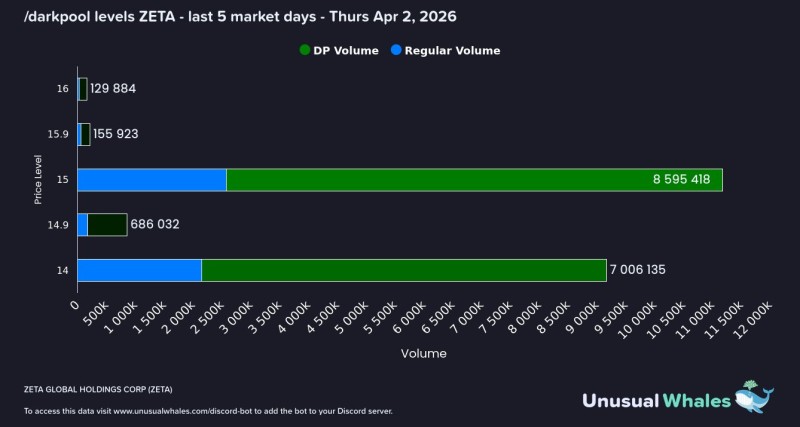
Both levels show strong dark pool participation, confirming that institutions are actively positioning within this narrow range. Unlike fragmented structures where volume is spread thin across many zones, this setup concentrates nearly all meaningful activity inside a single $1 band. That kind of clustering reflects deliberate positioning rather than random flow - a pattern consistent with broader ZETA accumulation phases where institutions anchor positions around specific price zones.
Why $15 Is the Immediate ZETA Pivot Point
Price is currently sitting directly at $15, which lines up with the largest volume node on the chart. That makes it the primary level defining short-term direction. With the highest concentration of demand concentrated here, $15 acts simultaneously as immediate support and the trigger point for any meaningful move higher.
With 8.6 million shares stacked at $15, this level is not just support - it is the entire thesis. A hold here opens the path upward with very little resistance in the way.
Above the current price, the chart shows very limited institutional volume. That absence of overhead supply is significant - it suggests resistance is relatively thin, meaning Zeta Global could move more freely if it manages to hold above this level and build momentum from it.
The Lower Tier That Stabilizes the ZETA Structure
Below the current price, $14 serves as a secondary support zone with around 7 million shares of dark pool volume behind it. This creates a layered defense rather than a single-point structure that can be blown through on one bad session. The relationship between the two levels defines the entire setup:
- $15 acts as the primary support and decision level
- $14 acts as a backstop if price pulls back
This type of two-tier base tends to provide real stability, because institutional demand is spread across nearby levels rather than crowded into one exact spot. A single gap-down or flush doesn't necessarily invalidate the thesis - there's a second layer to absorb the move. That same demand-zone framework has shown up in broader institutional floor setups across similar equities, where structured support ranges hold before expansion resumes.
Two levels. Nearly all the volume. One $1 band. This is as clean and readable as institutional positioning gets.
A Clean Setup With a Clear Path Forward
What makes this chart stand out is its simplicity. There are no competing zones to argue about, no ambiguous clusters scattered across five different levels. Just two institutional tiers that matter, with price sitting on the dominant one and another layer of demand directly below. Resistance above is thin. Support below is layered. The structure points in one direction - and structure, not speculation, is what defines the trade here.
 Saad Ullah