Marina Lyubimova

The ICE BofA MOVE Index, often called the "VIX of bonds," has climbed to 95 points - its highest reading since June 2025. It tracks expected yield volatility across 2-year, 5-year, 10-year, and 30-year US Treasuries, making it one of the most reliable stress gauges in fixed income. The surge reflects growing uncertainty around inflation expectations and the path of interest rates.
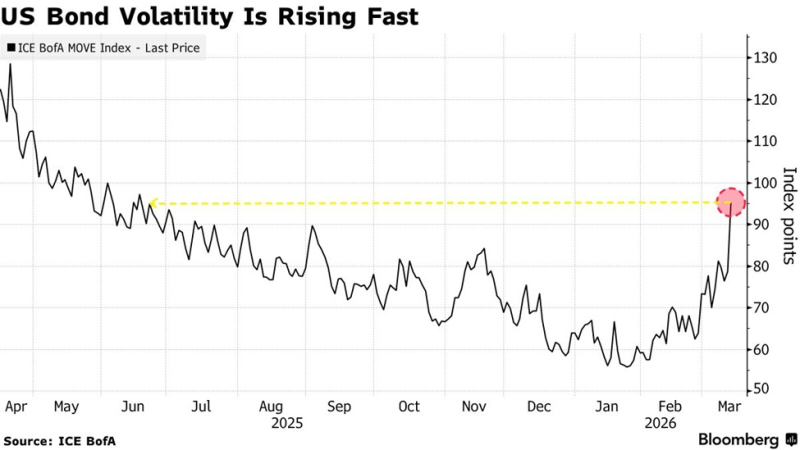
The move has been unusually fast. The MOVE Index jumped roughly 37 points, or about 64%, in just six weeks - the quickest rise since "Liberation Day." After trending lower through most of 2025, volatility reversed sharply in early 2026. Spikes like this typically signal that macro expectations are being repriced across the US Treasury market as trade war pressures intensify and the dollar weakens.
When the MOVE Index spikes this fast, it's not just bond traders paying attention - it's everyone repricing risk across every asset class.- Market commentary The Kobeissi Letter
Treasury yields have been climbing sharply across the curve. During the current month alone, the 10-year yield rose about 35 basis points to 4.28%, while the 30-year surged roughly 30 basis points to 4.90% - both nearing seven-month highs. This is consistent with broader macro shifts, where an Inflation vs Deflation Index breakout hints at a second inflationary wave taking hold.
Treasury yields serve as the global benchmark for borrowing costs, directly affecting mortgages, corporate debt, and sovereign spreads worldwide. When bond volatility spikes this quickly, it tends to ripple outward. Historical context matters here: as shown in the S&P 500's 16% gain in 2025 fitting 100 years of market history, macro cycles and rate dynamics have always shaped asset prices - and this cycle is no different.
 Marina Lyubimova