Eseandre Mordi

A powerful rally pushed SPY sharply higher, breaking through a key options-driven level and briefly shifting momentum in favor of buyers. As Mike Investing noted, the move was mechanically driven - a gamma squeeze tied to expiring JPMorgan collar options near the 6,475 level on the S&P 500. However, the follow-through quickly faded, and the chart now shows early signs that the index may be losing structural support after the squeeze-driven move.
Once price moved above that zone, dealer hedging flipped - turning from suppressing price action into accelerating it. This shift created a fast expansion higher, with momentum feeding on itself as the market cleared the negative gamma ceiling. The initial breakout was further supported by headlines around de-escalation in U.S.-Iran tensions, which helped trigger the first push through resistance.
SPY Chart Breaks Down After Hitting Channel Resistance
While the catalyst explains the rally, the chart tells a different story about sustainability.
Price surged into the upper boundary of a rising channel but failed to hold that position.
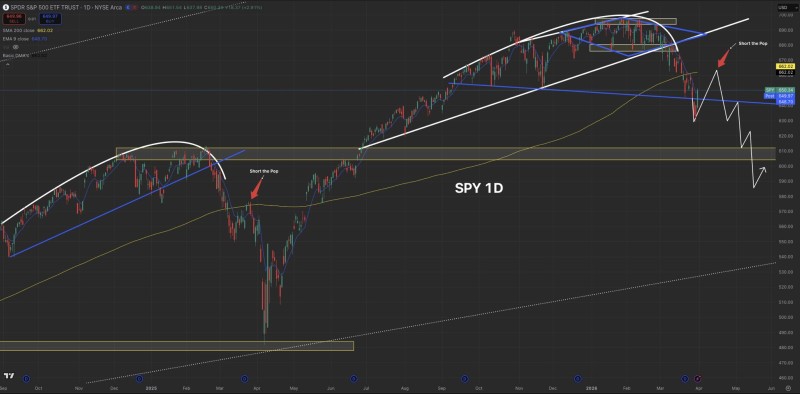
Instead of continuation, SPY quickly reversed, signaling exhaustion rather than genuine strength. This type of behavior often reflects a move driven by positioning rather than organic demand.
Several technical elements stand out:
Price action reverted to underlying trend signals visible on the chart - not a sustained structural breakout.
- The rising channel that defined the broader uptrend has been broken
- A tight consolidation near the highs resolved to the downside
- The breakout zone failed to hold as support
The 200-Day Moving Average at 660-662 Is Now the Key Battleground
The 200-day moving average, sitting near the 660-662 area, is now the most important level on the chart.
SPY is testing this zone after losing higher support levels. During the prior uptrend, this moving average acted as a dynamic floor. Now, price is interacting with it from above in a far less stable way. In S&P 500 technical analysis, losing the 200-day moving average often marks a broader shift in trend. The longer price struggles around this level, the more it suggests weakening control from buyers.
S&P 500 Structure Shifts, Not Just Momentum
Below current price, a key support zone sits around the 610-620 region - an area that previously acted as a base during earlier consolidation.
The chart's projected path reflects a sequence of lower highs and continued pressure, indicating a potential transition away from bullish structure. What was once a clean uptrend is now showing signs of instability:
- Lower highs beginning to form
- Former support turning into resistance
- Increased sensitivity around major moving averages
Breaks below this long-term average often signal structural deterioration in the trend.
This shift suggests that rallies may face selling pressure rather than immediate continuation.
The Signal Beneath the Noise
The SPY move highlights a key distinction in modern markets: not all rallies are equal.
The initial surge was driven by positioning and hedging flows, not by a sustained structural breakout. Once that flow faded, price action reverted to the underlying trend signals visible on the chart.
Right now, those signals point to a market at a turning point. If SPY fails to reclaim broken structure and hold above the 200-day moving average, the S&P 500 could transition into a phase where upside moves are increasingly sold - a subtle but critical shift in S&P 500 behavior that traders need to watch closely.
 Eseandre Mordi