
 Victoria Bazir

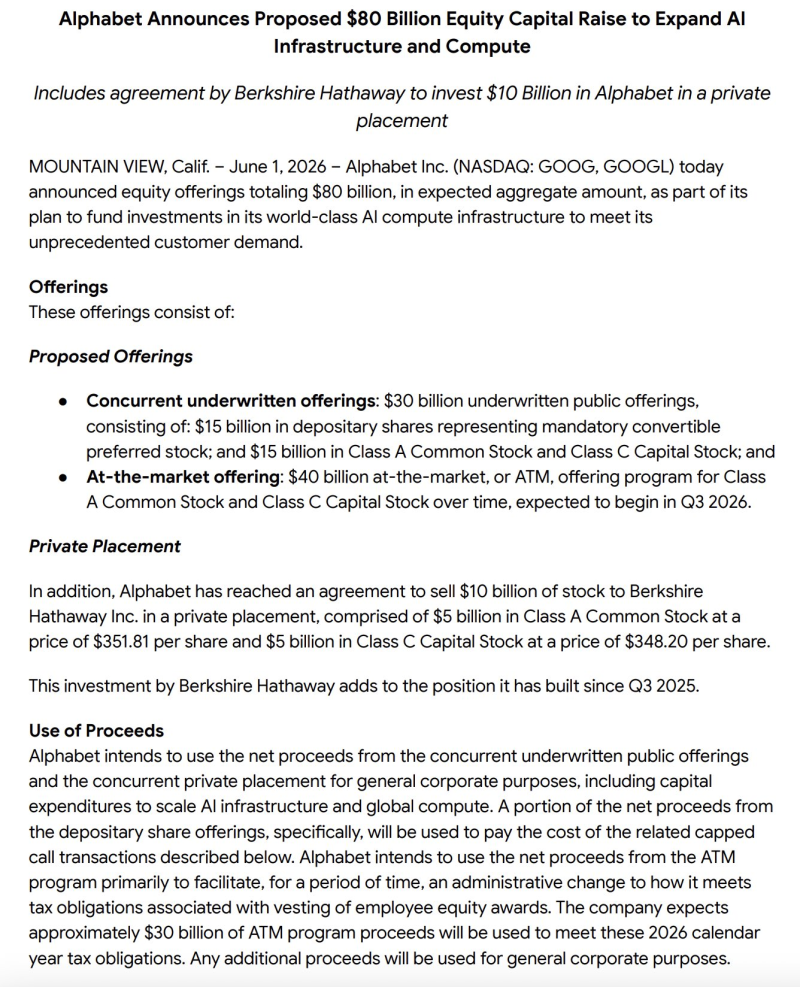
Alphabet is preparing to raise up to $80 billion through a combination of public offerings, an at-the-market stock program, and a private placement that includes a $10 billion investment from Berkshire Hathaway.
The proposed financing stands out less because of its structure and more because of its size. Alphabet already generates substantial cash flow and maintains one of the strongest balance sheets in the technology sector. Seeking capital on this scale suggests management expects infrastructure demand tied to artificial intelligence to remain elevated for years rather than quarters.
Compute Is Becoming the Scarce Resource
Investors have spent the last two years focusing on AI models, chatbots, and new applications. Behind the scenes, however, the largest technology companies have been competing for something far less visible: computing capacity.
Building and operating advanced AI systems requires enormous spending on data centers, GPUs, networking equipment, cooling systems, and power infrastructure. Those investments must be made long before the resulting revenue appears.
Alphabet's proposed raise suggests the company sees enough future demand to justify securing additional capital today rather than waiting for projects to be funded entirely through operating cash flow.
The size of the package also reflects how quickly AI economics are changing. Access to computing power is increasingly becoming a strategic asset rather than a simple operating expense.
Berkshire Hathaway's Role May Matter More Than Its Check
Berkshire Hathaway's planned $10 billion investment represents only a fraction of the overall raise, yet it may become one of the most closely watched parts of the transaction.
Berkshire rarely participates in deals tied to rapidly evolving technology trends. Its involvement places one of the world's most influential long-term investors alongside Alphabet's infrastructure strategy.
That does not guarantee success, but it does suggest that some institutional investors view AI infrastructure differently from previous technology cycles. The investment is tied to assets, capacity expansion, and long-term demand rather than speculation around a single product launch or model release.
The Impact Extends Beyond Alphabet
The significance of the proposal reaches well beyond Alphabet itself. Every large-scale infrastructure expansion creates demand across a broad supply chain that includes semiconductor manufacturers, networking providers, power equipment suppliers, cooling technology firms, and data center operators.
Companies such as Nvidia, Broadcom, Taiwan Semiconductor Manufacturing, Arista Networks, and Vertiv have already benefited from the surge in AI-related capital spending. A larger infrastructure push from Alphabet would reinforce the spending environment that has supported much of the sector's growth over the past two years.
The proposal also highlights a broader shift across the industry. Access to capital is becoming a competitive advantage in its own right. As infrastructure costs continue to rise, the largest technology companies may find it easier to widen the gap between themselves and smaller competitors.
Proposed Capital Raise Breakdown
| Source | Amount |
| Underwritten Public Offerings | $30 Billion |
| At-the-Market Program | $40 Billion |
| Berkshire Hathaway Private Placement | $10 Billion |
| Total | $80 Billion |
Alphabet's proposal is one of the clearest indications yet that major technology companies are planning for AI demand far beyond current deployment levels.
An $80 billion fundraising package only makes sense if management believes the next wave of infrastructure investment has not yet arrived. Whether that demand ultimately materializes remains to be seen, but the scale of the proposal suggests Alphabet is preparing for a market significantly larger than today's AI economy.
 Victoria Bazir



