Marina Lyubimova

The U.S. government has repurchased a significant portion of its own debt in what is now the largest buyback on record. As Barchart reported, the Treasury accepted $15 billion in securities - the maximum amount allocated for the operation - while total offers came in at over $43 billion, far exceeding what was ultimately accepted.
U.S. Treasury Confirms $15B Record Buyback
The official release confirms the full scope of the transaction.
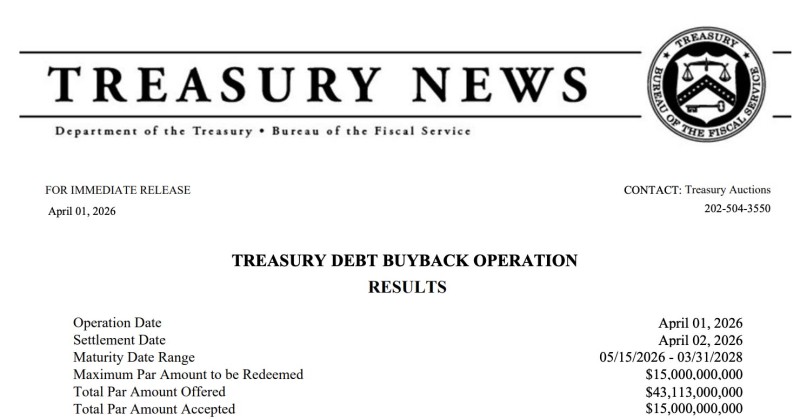
The buyback targeted securities with maturities ranging from May 2026 to March 2028, with settlement scheduled for April 2, 2026. The structure reflects a focused operation within a defined maturity window rather than a broad-based intervention.
The Treasury accepted the maximum allocated amount while receiving nearly three times more offers than it could take on - a clear signal of strong market participation.
The scale alone sets this apart from prior operations. Rather than a routine adjustment, this represents a deliberate and sizable step in how the government approaches its outstanding obligations.
Demand Far Exceeds $15 Billion Cap in Treasury Operation
One of the most notable elements in the data is the imbalance between supply and acceptance. The Treasury received nearly three times more offers than it ultimately accepted, reinforcing the scale of participation.
Key figures from the operation:
- Maximum accepted amount: $15 billion
- Total offered: $43.1 billion
- Maturity range: May 2026 - March 2028
This imbalance highlights strong willingness among holders to tender securities, even within a capped operation. Demand of this magnitude suggests that market participants saw clear value in participating, regardless of the strict limits in place.
A Measured Approach to U.S. Debt Management
The fixed cap at $15 billion stands out as the defining parameter of this operation. Despite substantial participation, the Treasury maintained strict control over the accepted amount - a deliberate and measured approach rather than an open-ended buyback.
US Debt Hits $39T as Treasury Borrowing Accelerates - and operations like this one are increasingly part of how the government manages that load. The goals typically include improving liquidity in specific maturity segments and maintaining orderly market functioning.
At the same time, total U.S. obligations recently surpassed $39 trillion, which adds broader context to why such operations are drawing more attention. U.S. Treasury Repurchases $2 Billion in Long-Term Bonds - a figure that now looks modest compared to the scale of this latest action.
Managing debt across specific maturity windows is becoming a more visible part of Treasury strategy, particularly as total obligations continue to climb.
The current environment makes active debt management not just practical but necessary. US Inflation Drops Below 1%: TruCPI Hits 0.94% YoY - a shift in the inflation picture that gives policymakers more room to maneuver on the debt side without additional market pressure.
 Marina Lyubimova