Alex Dudov

For Anthropic, hiring Andrej Karpathy is not a branding move. It is a bet on training infrastructure. Karpathy led Autopilot AI at Tesla during the company’s large-scale vision and data engine expansion, then returned to OpenAI to work on midtraining and synthetic data generation. Those areas are becoming critical as frontier AI labs hit scaling limits.
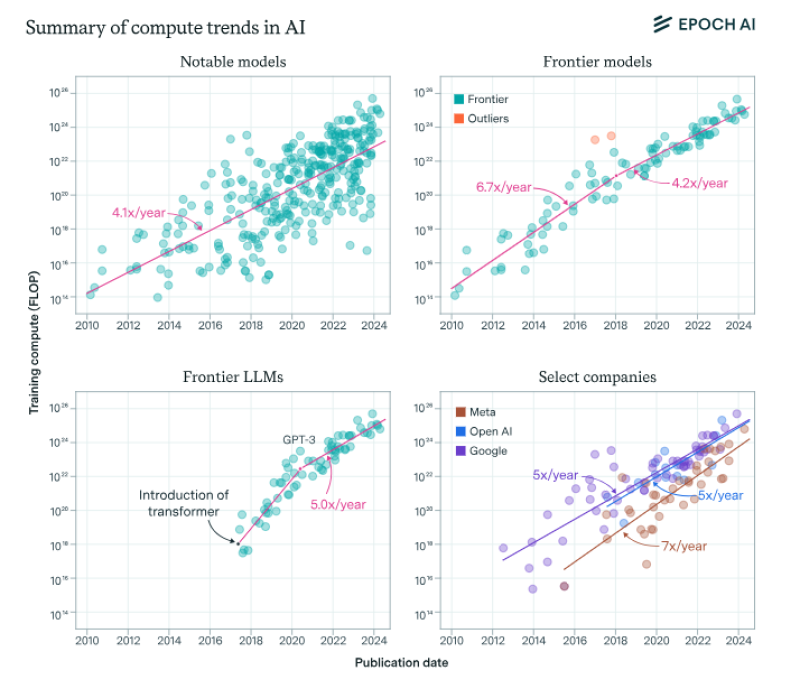
Epoch AI estimates training compute for frontier LLMs has grown roughly 5x per year since the transformer era accelerated modern AI development.
According to Epoch AI research, training compute for frontier LLMs has been increasing at roughly 5x per year since around 2018. Models such as GPT-3, PaLM, GPT-4, and Gemini Ultra illustrate how quickly frontier AI development has become more compute-intensive.
That shift changes the competitive landscape. The industry is no longer competing only on model size. Frontier labs now need better synthetic data pipelines, stronger post-training systems, and more efficient refinement loops. As benchmark performance starts converging across major models, training methodology itself is becoming a strategic advantage.
That is where Karpathy fits. Anthropic already has a reputation for stable long-context models and strong enterprise reliability. Karpathy strengthens a different layer of the stack: how models are trained, refined, and improved after pretraining.
The hire also signals growing competition for elite AI talent. Frontier AI increasingly resembles the semiconductor industry, where a small number of researchers can materially influence product direction and capability progress.
Anthropic was viewed primarily as the cautious lab focused on safety and reliability. Bringing in Karpathy suggests the company wants to be seen differently: not just as a responsible AI company, but as one of the labs shaping the next generation of training systems.
 Alex Dudov