Eseandre Mordi

Austria's 100-year government bond, the 2.5% 2117 issue, has seen one of the biggest drops in modern sovereign debt history. Its price climbed close to 237 when interest rates were very low, but recently it has fallen to around 60. Investors who bought near the peak have lost about three-quarters of their money. This shows how even small changes in yield expectations can have a big impact on long-term bonds.
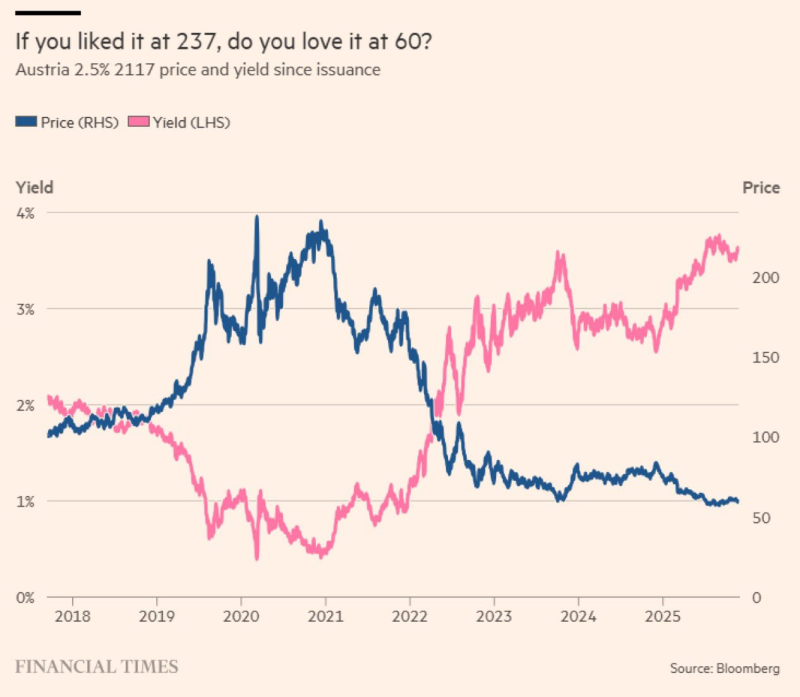
The inverse relationship between price and yield played out in full view. Through the late 2010s and early pandemic period, falling global rates pushed demand for long-duration assets sharply higher. But when monetary tightening began around 2021 and 2022, yields reversed and bond prices followed. Similar dynamics have reshaped sovereign debt markets globally, including the France vs. Italy: Historic 10-Year Yield Spread Inversion, where long-dated fiscal risks came back into focus.
Ultra-long bonds are uniquely exposed to rate cycles — a small move in yields can erase decades of expected returns.
Because the Austria 2117 bond's cash flows stretch over a century, rising rates hit it harder than almost any other instrument. Higher yields reduce the present value of distant payments, creating steep price declines that compound across the full duration. The pattern extends beyond Europe, with Japan's 30-Year Bond Yield hitting a record near 3.5% as long-term sovereign debt repriced in parallel.
The Austria bond's collapse has become a defining case study in the risks of ultra-long government debt. It shows how quickly financial conditions can shift when rate cycles turn. These moves are part of a broader structural repricing across sovereign markets, where inflation expectations and central bank outlooks continue to redraw the global yield curve, as reflected in the US Treasury Yield Spread hitting 69 basis points as the curve steepens toward a four-year high.
 Eseandre Mordi