Eseandre Mordi

Nigeria's inflation is stabilizing. The latest figures show the country's year-over-year price growth sitting at 15.06%, while M3 money supply expansion has pulled back to 13.21% -- well below the threshold economists typically associate with the current inflation target.
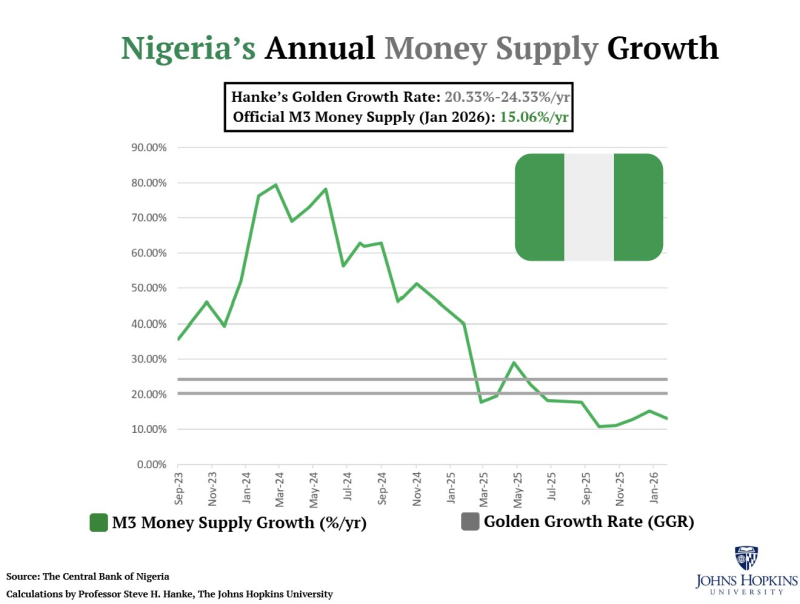
M3 Money Supply Drops from 70% Peak to 13.21% in Early 2026
The shift in monetary conditions has been dramatic. After M3 money supply growth surged past 70% in early 2024, it has since reversed sharply, landing at 13.21% as of January 2026. That puts Nigeria below the Golden Growth Rate range of 20.33% to 24.33% -- a benchmark linked to inflation between 14.5% and 18.5%. The normalization trend is visible and sustained.
How Nigeria's Trend Compares to Colombia and Japan
Nigeria's pattern mirrors dynamics seen elsewhere. Colombia Inflation Stays at 5.35% as Money Supply Growth Hits 10.9% shows how excess liquidity can keep inflation elevated longer than expected. On the other end of the spectrum, JPY Tracks Japan's Inflation Miss as M2 Money Growth Sits at Just 1.56% illustrates that restrictive monetary conditions tend to drag prices lower. Nigeria currently sits between these two extremes -- inflation present but no longer accelerating.
The core takeaway is straightforward: as liquidity expansion slows, inflation tends to follow. Nigeria's data supports that relationship. With M3 growth now trailing the Golden Growth Rate, the conditions for further disinflation appear to be building. Whether the trend holds depends on how monetary policy evolves from here.
 Eseandre Mordi