Eseandre Mordi

A subtle but important shift is taking shape in the US economic outlook. Goldman Sachs has trimmed its 2026 growth forecast while increasing recession probability, signaling that rising oil prices are beginning to weigh on expectations - even before any material slowdown fully appears in the data.
Goldman Sachs Cuts 2026 GDP Forecast to 2.1% as Recession Odds Hit 30%
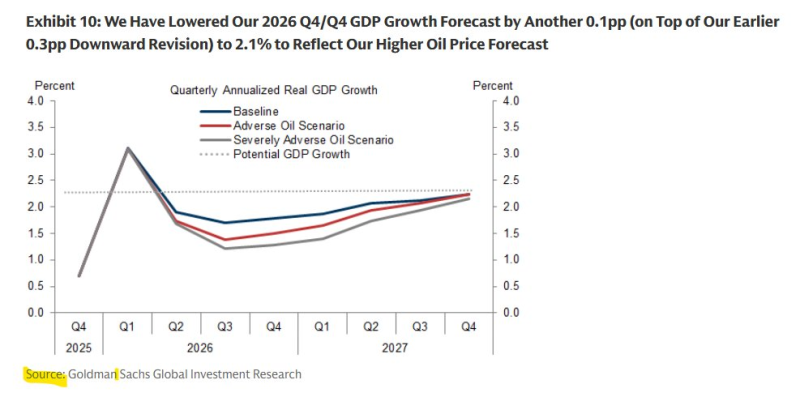
As Neil Sethi noted, Goldman now expects 2.1% GDP growth on a Q4/Q4 basis, following an additional 0.1 percentage point downgrade on top of an earlier 0.3 point cut. The baseline trajectory trends lower into 2026 before stabilizing - a visual confirmation that the revision reflects a structural shift in expectations, not just a one-time adjustment.
Goldman increased its 12-month recession probability by 5 percentage points to 30%, underscoring a growing imbalance between risks and expected outcomes.
Alongside the growth cut, that recession probability increase signals something more than routine caution. It means the range of bad outcomes is becoming harder to dismiss.
US GDP Growth in 2026 Falls Short of 2.3% Potential Across All Scenarios
The dotted line representing potential GDP of roughly 2.3% is the key benchmark here. Across most of 2026, every scenario falls below it, including the baseline. After a brief spike above 3% in early 2026, the chart shows a clear deceleration toward:
- 2.1% in the baseline scenario
- ~1.9% in the adverse oil scenario
- ~1.8% in the severely adverse case
This persistent gap below potential describes an economy that keeps growing, but without enough momentum to fully utilize its capacity. It's expansion without vigor.
The balance of risks is shifting. Downside scenarios are no longer distant - they are embedded within the central outlook.
One of the more striking features of the projections is how tightly grouped the three paths have become, especially through mid-2026. The compression between baseline and downside scenarios means that even modest shocks - particularly from energy prices - could push growth toward the lower-bound outcomes without much warning. Brent Oil Calendar Spread Hits Record $25 Backwardation in March 2026 illustrates exactly the kind of tightening energy conditions feeding into this dynamic.
Oil Supply Risks Add Pressure to the US GDP Growth Outlook
The downside scenarios aren't hypothetical. Brent Oil Tops $100 as Hormuz Closure Puts 20% of Global Supply at Risk shows the type of supply shock that can translate directly into slower growth expectations.
The chart doesn't point to an imminent contraction. What it shows is a clear deceleration in growth momentum, a narrowing gap between the baseline and the bad scenarios, and a rise in recession probability that reflects exactly that narrowing. The economy isn't falling - but it has considerably less cushion than it did a year ago.
 Eseandre Mordi