Eseandre Mordi

After years of volatility, Hong Kong’s economy has delivered its strongest growth print in nearly five years - but the data shows this is more than just a rebound.
Hong Kong’s economy has just posted 5.9% growth, the fastest pace in almost five years. On the surface, that looks like a clear recovery signal. But to understand what’s really happening, it’s important to look beyond the headline and into the broader trend.
The chart below provides that context.
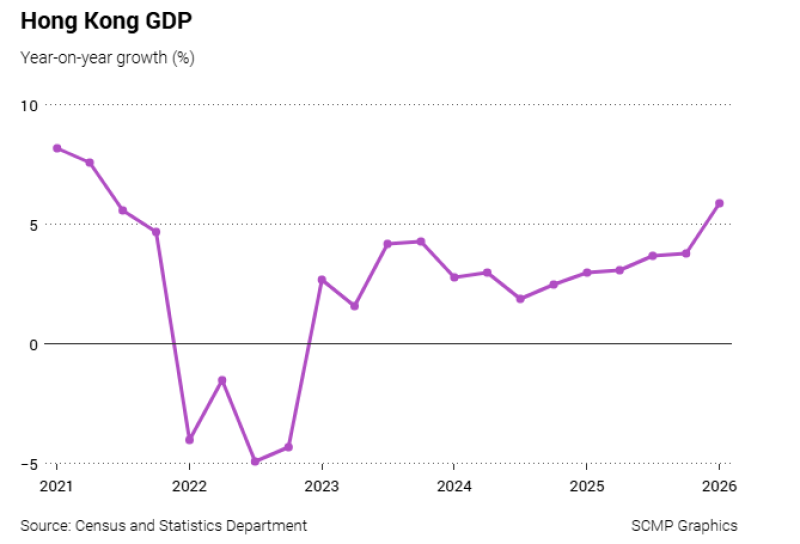
Hong Kong GDP growth trend (Source: SCMP, Census and Statistics Department)
What stands out immediately is the volatility of the past few years. Just two years ago, the economy was contracting sharply, dipping deep into negative territory in 2022. That period reflected pandemic restrictions, weak external demand, and tighter financial conditions.
The rebound in 2023 marked a turning point. Growth returned to positive territory, but not in a straight line. Instead, the recovery unfolded in phases - expanding, slowing, then picking up again. The latest jump to 5.9% sits at the top of this recovery curve. It is not an isolated spike, but the highest point in a gradual upward trend that has been building over multiple quarters.

A major factor is external demand. Hong Kong is one of the most open economies in the world, with trade flows exceeding several times its GDP. As regional trade strengthens - particularly within Asia - it directly supports logistics, finance, and cross-border services.
According to Reuters, Hong Kong’s exports rose 23.8%, imports increased 29.9%, and private consumption grew 5.0%, showing that the rebound was supported by both external trade and domestic demand.
Financial activity is another key driver. As market conditions stabilize, capital flows and trading volumes increase. For a global financial hub, even incremental improvements in sentiment can translate into meaningful economic impact. At the same time, services are recovering. Tourism, retail, and transportation sectors that were heavily impacted in previous years are now contributing to the upswing as travel and consumption normalize.
However, the chart also highlights an important nuance. The strong 5.9% figure comes after a period of weakness, meaning part of the growth reflects base effects. When the starting point is low, the rebound appears stronger in percentage terms. This is why the broader trend matters more than a single data point. The trajectory is clearly positive, but still dependent on external conditions. Hong Kong remains highly sensitive to global trade cycles, financial market shifts, and regional economic performance.

Hong Kong’s rebound is not just a local story. As one of Asia’s key financial hubs, its growth signals improving regional trade flows, stabilizing capital markets, and a potential shift in investor sentiment toward Asia. Stronger activity in Hong Kong often reflects broader momentum across China-linked and global financial systems.
 Eseandre Mordi