Artem Voloskovets

Bullish has announced a $4.2 billion acquisition of Equiniti, a firm that manages over 20 million shareholders and processes more than $500 billion in annual payments. The scale of the deal positions Bullish at the intersection of traditional financial infrastructure and emerging blockchain-based systems.
Market reaction shows repricing, not rejection
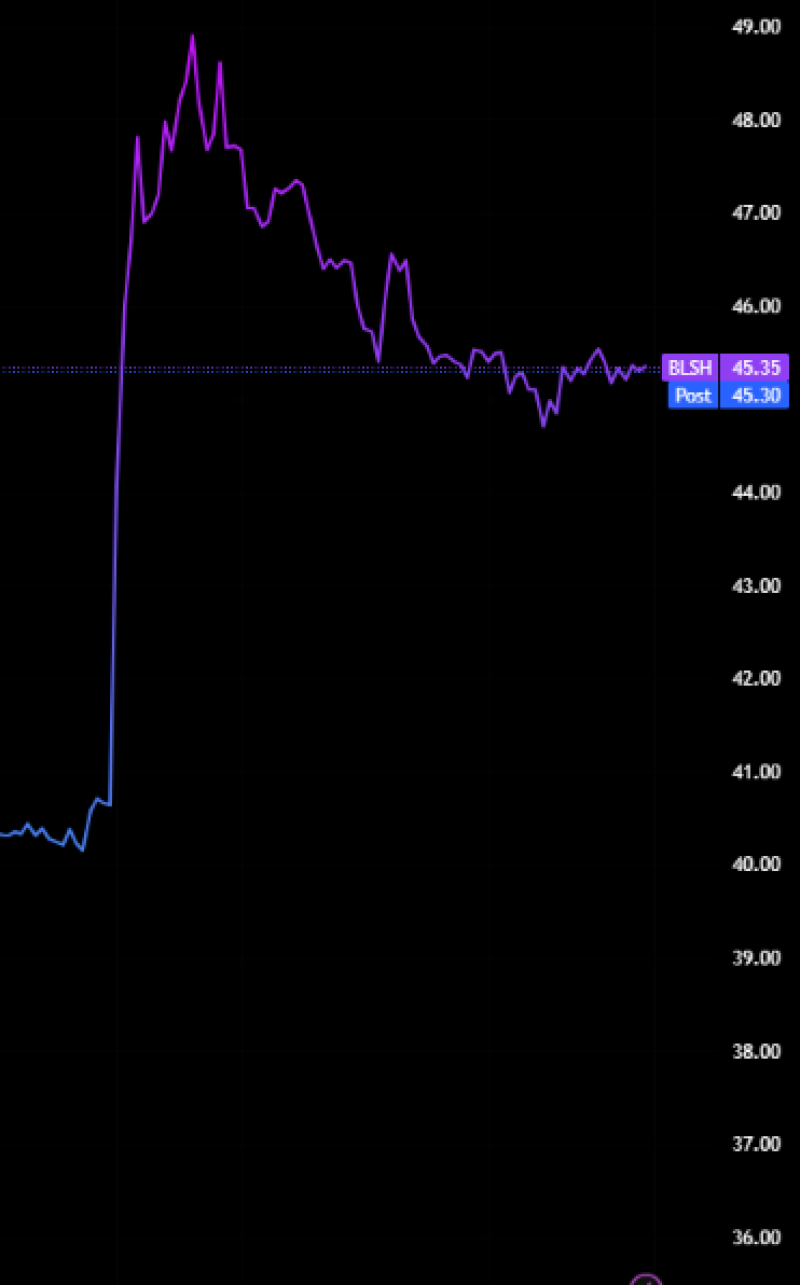
The market reaction to the acquisition highlights a clear repricing dynamic. Bullish shares surged sharply from around the 40 level to nearly 49, reflecting an immediate positive response to the announcement.
Following the initial spike, the stock pulled back but stabilized near the 45 level, holding well above pre-announcement prices. This pattern suggests that while short-term traders took profits, the market retained a significant portion of the gains. Such price behavior typically indicates that the move was not fully reversed, but rather transitioned into a new equilibrium, with investors reassessing the company’s valuation in light of the deal.
Equiniti’s footprint in shareholder services and large-scale payment processing introduces a significant real-world layer to Bullish’s ecosystem. With access to millions of investor accounts and high-volume transaction flows, the acquisition expands beyond crypto-native markets into core financial infrastructure.
The move comes as tokenized securities and real-world assets (RWA) gain traction across the industry. Blockchain-based systems are increasingly being used to represent ownership, settle transactions, and manage financial flows traditionally handled by centralized intermediaries. Bullish’s positioning suggests a strategic attempt to integrate these capabilities directly into existing financial pipelines, rather than building isolated crypto-native systems.
Strategic shift toward tokenized infrastructure
The acquisition reflects a broader shift toward combining traditional finance with blockchain-based settlement layers. By integrating Equiniti’s operational scale with digital asset infrastructure, Bullish may be aiming to streamline shareholder management, payments, and asset ownership through tokenized systems.
This approach aligns with a growing industry trend where real-world assets are increasingly represented and transacted on-chain, reducing friction and increasing transparency across financial operations.
Conclusion
The $4.2 billion acquisition of Equiniti marks a significant expansion of Bullish into traditional financial infrastructure. Market reaction suggests that investors are pricing in the strategic importance of the deal, as the stock remains elevated even after the initial spike. If execution follows, the move could accelerate the convergence between legacy financial systems and tokenized asset infrastructure, positioning Bullish as a key player in the evolving structure of global finance.
 Artem Voloskovets