Sergey Diakov

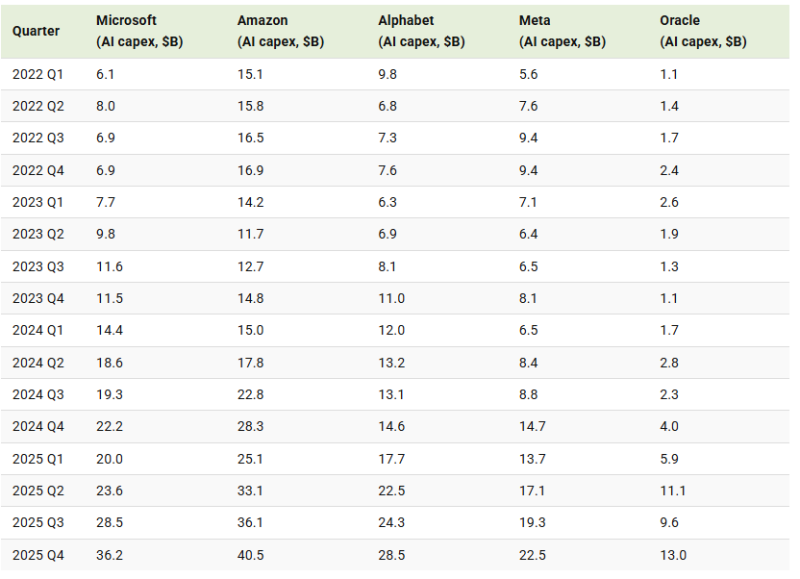
The table shows how AI-related capital spending by major tech companies has evolved over the past three years. At first, the numbers look manageable. In early 2022, Microsoft was spending around $6–8 billion per quarter, Amazon about $15–16 billion, and other players even less.
But the trend doesn’t stay stable for long.
By 2024, spending begins to accelerate noticeably. Microsoft moves into the $18–22 billion range per quarter, Amazon pushes above $20 billion, and Alphabet steadily climbs past $13–14 billion. What was once gradual growth starts turning into expansion.
Then comes 2025, where the shift becomes unmistakable. Amazon reaches over $40 billion in a single quarter, Microsoft climbs above $36 billion, and Alphabet approaches $30 billion. Even companies that started from smaller bases, like Oracle and Meta, show sharp increases. At this point, the numbers are no longer incremental - they are scaling.
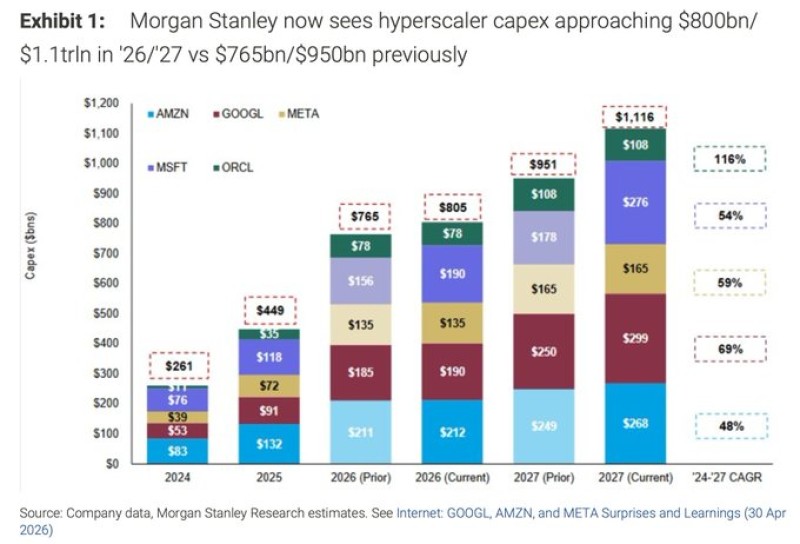
This real-world acceleration helps explain the projections shown in the Morgan Stanley chart. When analysts raise forecasts from $765 billion to $805 billion for 2026, and from $951 billion to over $1.1 trillion for 2027, they are reacting to exactly this kind of trend. The quarterly data shows that spending is not just growing - it is compounding quickly.
The reason behind this surge is the infrastructure required for artificial intelligence. AI systems demand large-scale data centers, advanced chips, and high-performance networking. These are capital-intensive investments that must be made before revenue is fully realized, which is why spending rises so sharply in advance.
Another important takeaway from the table is that the increase is broad. Amazon and Microsoft lead in absolute terms, reflecting their cloud dominance, but Alphabet, Meta, and even Oracle are all scaling aggressively. This suggests that AI investment is not optional. Companies are increasing spending in parallel, which reinforces the idea of an industry-wide race.
When you combine the quarterly data with the long-term projections, a clearer picture emerges. The move toward $1 trillion in annual capex is not a distant or abstract forecast - it is the continuation of a trend that is already visible in the data today.
The quarterly numbers show how quickly AI spending is accelerating, while the Morgan Stanley forecast shows where that trajectory leads - toward a trillion-dollar investment cycle driven by infrastructure, not experimentation.
 Sergey Diakov