Victoria Bazir

The US bond market may be approaching a pivotal turning point. After more than four decades of steadily declining yields, the US 10-year Treasury is now showing signs of a sustained reversal.
The move from near-zero levels to above 4% is not just another cycle fluctuation - it directly challenges one of the most consistent long-term trends in modern financial history. What was once a structural downtrend is now being tested in a meaningful way.
A 40-year decline defines the bond market
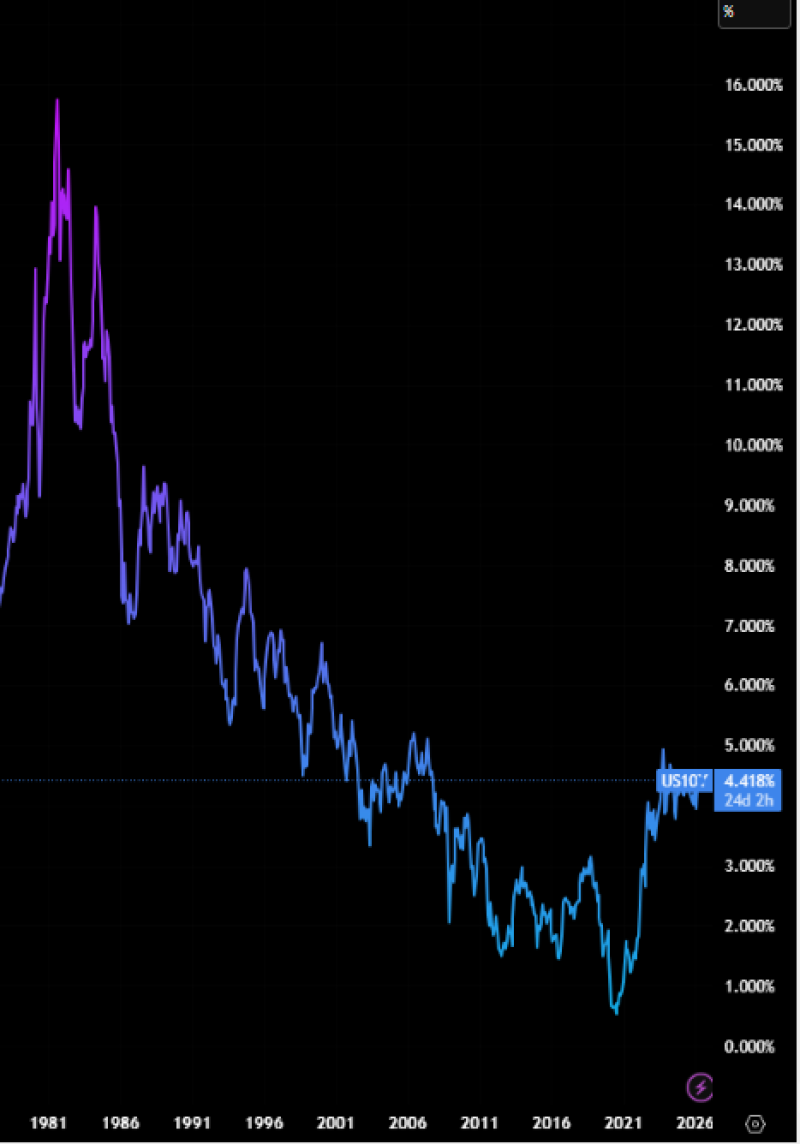
The US 10-year Treasury yield has followed a persistent downward trajectory since the early 1980s, falling from peaks above 15% to near-zero levels by 2020–2021.
This long-term structure is clearly visible on the chart, with a consistent pattern of lower highs and lower lows over multiple decades. This trend has been a defining force behind global asset pricing, supporting equities, credit markets, and long-duration assets.
A sharp reversal challenges the trend
After bottoming near the 1% level, yields began to move higher, accelerating sharply through 2022–2023. The move pushed the US 10-year yield above the 4% level, marking the strongest upside shift in decades.
On the chart, this reversal stands out as a clear break in behavior. Unlike previous rebounds that failed and led to new lows, the current move has sustained itself at significantly higher levels. This challenges the validity of the long-standing downtrend rather than simply fitting within it.
Inflation acceleration reshapes the backdrop
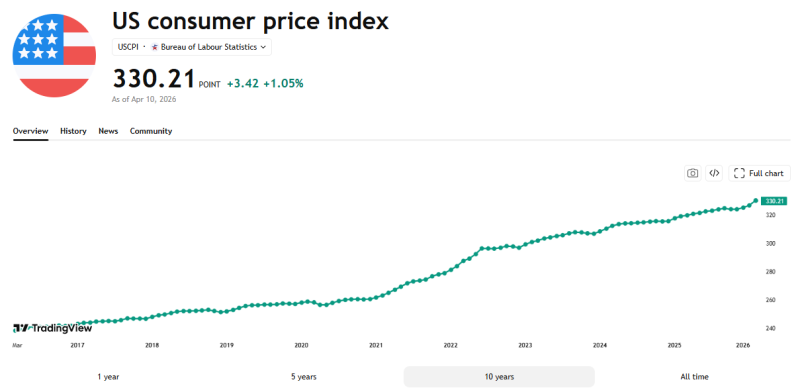
The inflation backdrop has also shifted in recent years. While the CPI index has been rising steadily over time, the chart shows a clear acceleration in price growth starting around 2021, as the slope becomes noticeably steeper.
This change is critical. The 40-year decline in yields was built on a foundation of stable and subdued inflation. As price growth accelerated, bond markets were forced to reprice expectations, contributing directly to the sharp rise in yields.
Higher lows reinforce structural pressure
Recent price action shows the yield stabilizing around 4.4%, with a sequence of higher lows forming after the rebound. This is a meaningful structural shift. Instead of returning to previous lows, yields are holding elevated levels, signaling persistent pressure on the old trend. The market is no longer behaving as it did during the prior cycle.
From trend to regime shift
The data raises a fundamental question: is this a cyclical rebound, or the beginning of a new regime? If sustained, this move could mark the end of the long-term bond bull market that has defined global financial conditions for decades. Such a shift would have far-reaching implications for equities, valuations, and capital flows worldwide.
Conclusion
The US 10-year Treasury yield has rebounded sharply from historic lows and is now holding above 4%, directly challenging a 40-year downtrend. At the same time, accelerating inflation dynamics are undermining the conditions that supported that trend.
The data does not yet confirm a complete structural break - but it clearly shows that the foundation of the long-term bond rally is no longer intact. If current dynamics persist, global markets may be entering a fundamentally different rate environment.
 Victoria Bazir