Victoria Bazir

Tokenization has been discussed for years as a future upgrade to financial markets. What’s changing now is that it’s moving out of theory and into infrastructure. DTCC is preparing to launch a tokenization service for real-world assets, as on-chain adoption accelerates and projections point to a multi-trillion-dollar market.
To understand the significance of this move, it helps to start with what already exists - not forecasts, but real data.
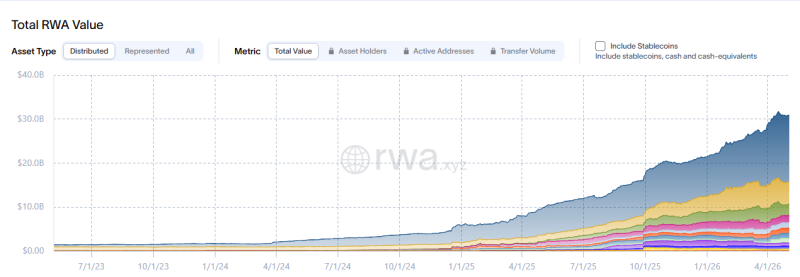
Below, on-chain metrics show how tokenized real-world assets have been steadily growing. What began as a niche segment has expanded into tens of billions of dollars, with increasing activity across asset classes such as U.S. Treasuries, credit products, and stablecoin-linked instruments. The growth is not explosive yet, but it is consistent, and more importantly, it is accelerating.
This is the environment DTCC is stepping into. Through its subsidiary DTC, the firm already holds and processes assets worth over $114 trillion. Its new tokenization service is designed to represent those same assets on blockchain infrastructure, while preserving ownership rights, protections, and settlement integrity.
The timeline shows how close this transition is. DTCC plans to facilitate initial production trades in July 2026, followed by a broader launch in October 2026. That shift from pilot to production - is critical. It means tokenized assets will begin operating within the same system that supports traditional markets.
What makes this development more than a technical upgrade is the level of coordination across the industry. More than 50 firms, spanning both traditional finance and crypto-native players, are involved in shaping the system. The goal is not to replace existing infrastructure, but to extend it - connecting traditional securities with blockchain-based rails.
To see where this is heading, it’s useful to zoom out.
Long-term projections suggest that the current growth is only the early phase of a much larger shift. Estimates from industry research indicate that tokenized assets could scale into a multi-trillion-dollar market over the next decade, potentially exceeding $10–20 trillion depending on adoption scenarios.
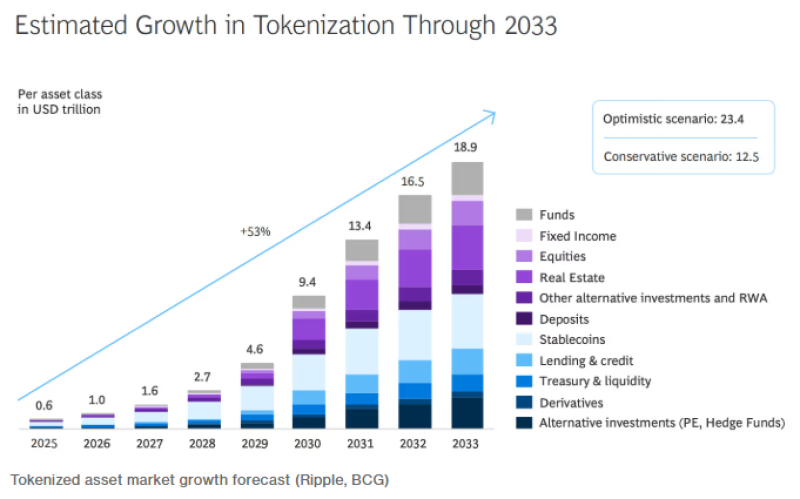
The contrast between the two charts is important. The first shows what is happening now: steady, measurable adoption. The second shows what happens if that adoption continues at scale. DTCC’s role sits directly between those two realities - bridging today’s infrastructure with tomorrow’s market size.
Another key element is how the system is being introduced. The service is launching under a defined regulatory framework, following a No-Action Letter from the SEC. Initially, it will focus on highly liquid assets such as large-cap equities, ETFs, and U.S. Treasuries. This suggests a controlled rollout, where tokenization is applied first to markets that already function efficiently.
From an operational perspective, the emphasis is on interoperability. Tokenized assets need to function across different blockchain environments while remaining integrated with existing financial systems. Without that, scaling beyond niche use cases would be difficult.
Taken together, the data and the timeline point to the same conclusion. Tokenization is not arriving as a sudden disruption - it is being layered onto the existing system, gradually but deliberately.
 Victoria Bazir