Artem Voloskovets

Inflation in the euro area has picked up again, with the headline rate rising to 2.5% in March from 1.9% in February. Data shared by EU Eurostat shows a broad increase across key components, signaling renewed price pressure after a brief cooling phase.
Energy leads the acceleration with a 4.9% rise - the highest among all components and the primary driver behind the rebound in headline inflation. The structure of the move tells a clear story: this is not a single-category spike, but a broad-based increase pulling the headline number higher.
Energy at 4.9% Drives Eurozone Inflation Higher
Services follow with a 3.2% increase, maintaining relatively elevated levels compared to other categories. Food, alcohol, and tobacco rose by 2.4%, contributing moderately, while non-energy industrial goods remain subdued at just 0.5%.
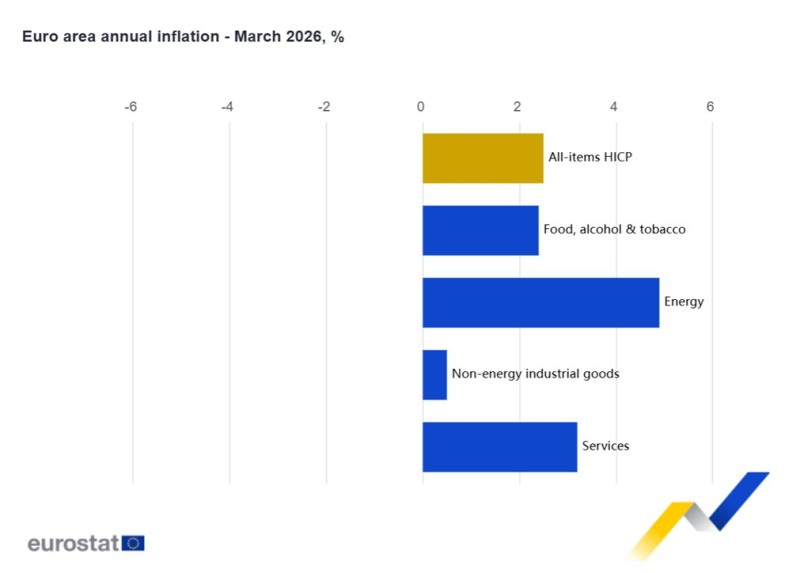
The structure clearly shows that inflation is not being driven by a single outlier, but by multiple categories moving higher at the same time.
Energy and services are moving simultaneously - that combination tends to be the most persistent form of inflation pressure.
March 2025 Reversal Follows February's Cooling Trend
The move from 1.9% to 2.5% marks a notable shift in momentum. Just a month earlier, Euro Area Inflation Hits 1.9% in February 2026, Nearing ECB Target - suggesting the headline rate was stabilizing near the European Central Bank's 2% threshold.
Now, the latest data reflects a renewed increase, pushing inflation back above that level. This kind of reversal highlights how quickly price dynamics can shift, especially when energy and services begin to accelerate simultaneously.
The move from 1.9% to 2.5% in a single month is a reminder that stabilization phases can be temporary when energy costs remain volatile.
Uneven Pressure Across Inflation Components
The breakdown of inflation components shows a clear imbalance:
- Energy: 4.9% (strongest contributor)
- Services: 3.2% (persistent upward pressure)
- Food, alcohol & tobacco: 2.4% (moderate increase)
- Non-energy industrial goods: 0.5% (weakest growth)
This distribution suggests that goods inflation remains relatively contained, while services and energy continue to exert the most upward pressure on the overall index. Earlier data covering Euro Area Inflation Slows to 1.7% in January 2026, With Romania Leading at 8.5% shows just how much ground has been covered in a short period.
When goods inflation stays flat while services hold above 3%, the overall picture becomes harder to resolve through demand-side adjustments alone.
What the March 2026 Inflation Signal Means for Markets
The latest reading reinforces that inflation in the euro area remains sensitive to shifts in key components. While recent months showed signs of stabilization, the March data indicates that price pressures are not fully settled.
The composition of inflation will remain critical going forward, particularly with energy and services leading the current move. The broader context - including the question of Eurozone Inflation Hitting 2% and Whether Rate Cuts or Core Pressure Are Next - remains squarely in focus for policymakers and markets alike.
For now, the data signals a renewed upward shift, with multiple components contributing to the increase - keeping eurozone inflation dynamics firmly on the agenda.
 Artem Voloskovets