Artem Voloskovets

American Bitcoin just delivered its strongest quarter on record, mining 817 BTC in Q1 while increasing its Bitcoin reserves to more than 7,000 BTC. The company also acquired roughly 803 additional BTC through treasury purchases, bringing total holdings sharply higher during the quarter.
More importantly, the company says it did not sell a single Bitcoin while maintaining mining margins above 50%, signaling growing confidence in Bitcoin’s long-term upside potential rather than short-term liquidation strategies.
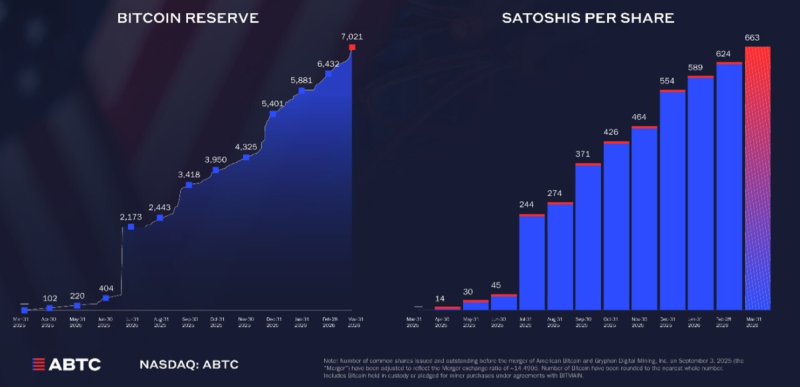
Use the ABTC reserve growth chart directly after the paragraph above.
Caption: American Bitcoin expanded its Bitcoin reserve above 7,000 BTC while continuing to increase its Bitcoin-per-share metric throughout Q1 2026.
The chart visually confirms the company’s aggressive accumulation strategy, showing steady reserve growth from roughly 5,400 BTC to more than 7,000 BTC within months. It also highlights rising “Satoshis Per Share,” a metric increasingly used by Bitcoin-focused firms to demonstrate shareholder exposure to BTC growth over time.
The development may reflect a broader transformation inside the Bitcoin mining sector. Traditionally, many miners were forced to sell large portions of mined BTC to cover operational expenses and debt obligations. American Bitcoin appears to be taking the opposite approach by treating Bitcoin not simply as mined inventory, but as a strategic reserve asset.
If other mining companies begin reducing sell pressure and prioritizing treasury accumulation, the long-term impact on Bitcoin’s circulating supply could become significant. That possibility becomes even more important following the latest Bitcoin halving, which already reduced new BTC issuance across the network.
The strategy also aligns with the growing institutional narrative surrounding Bitcoin scarcity. Between ETF inflows, corporate treasury adoption, sovereign interest, and lower miner selling activity, several market participants believe Bitcoin could enter a structurally tighter supply environment over the coming years.
Still, the approach carries risks. Holding large BTC reserves instead of locking in profits increases exposure to volatility, particularly if Bitcoin experiences sharp corrections or mining economics weaken due to energy costs or regulatory pressure.
Even so, American Bitcoin’s decision to hold every mined coin during a record production quarter sends a strong message to the market: some of the industry’s largest players increasingly appear to be positioning for substantially higher Bitcoin prices ahead rather than preparing to exit current levels.
 Artem Voloskovets