Victoria Bazir
Tesla’s autonomous ambitions appear to be scaling faster than many investors expected.
Tesla Austin Robotaxi Fleet Growth
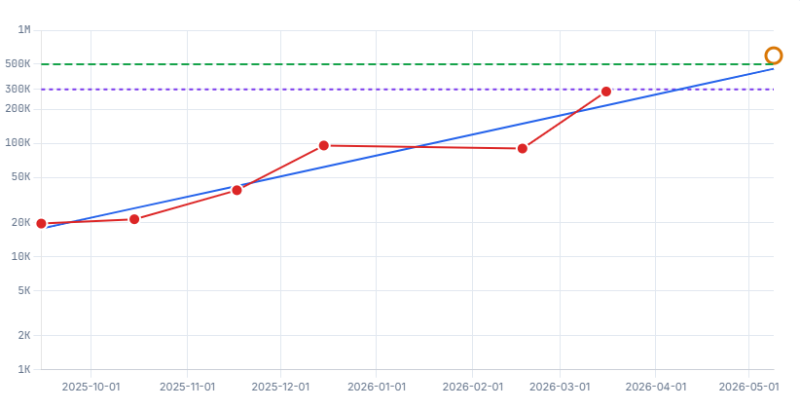
Third-party tracking data suggests Tesla’s Austin Robotaxi fleet expanded rapidly between mid-2025 and May 2026, highlighting accelerating autonomous deployment momentum.
According to third-party tracking data, Tesla’s Austin Robotaxi fleet has expanded from roughly 10 vehicles in July 2025 to nearly 100 vehicles today — representing close to 9x growth in less than a year.
While Tesla has not officially disclosed Robotaxi fleet metrics, the reported ramp suggests the company may already be moving from limited pilot deployment toward early-stage network scaling. The growth appears to have occurred in distinct waves:
- July 2025: around 10 vehicles
- Q4 2025: roughly 20–30 vehicles
- February 2026: about 50 vehicles
- Today: more than 95 vehicles
The acceleration is drawing renewed attention to Tesla’s long-term autonomous driving thesis and its potential impact on the company’s valuation.
Tesla’s Robotaxi Narrative Is Becoming Operational
For years, Tesla’s Robotaxi vision was largely treated as a future promise tied to Full Self-Driving software progress. Now investors are increasingly watching real-world deployment metrics instead of product demos alone.
The Austin fleet expansion matters because it potentially signals that Tesla is beginning to operationalize autonomous transportation infrastructure rather than simply testing isolated vehicles. Even though the numbers remain relatively small compared to traditional ride-hailing fleets, the pace of scaling is what stands out.
A rapidly expanding autonomous network creates significantly more:
- route data
- edge-case training
- traffic interaction modeling
- passenger behavior feedback
- operational testing conditions
That data loop is critical for autonomous driving systems because fleet learning compounds over time. The larger the active network becomes, the faster Tesla can theoretically improve its self-driving stack.
Wall Street Is Watching for the “Scaling Moment”
The Robotaxi market has become one of the most important long-term narratives surrounding Tesla stock. Bulls have argued for years that autonomous ride-hailing could eventually transform Tesla from a car manufacturer into a high-margin mobility platform.
Skeptics, however, have repeatedly questioned:
- regulatory approval
- real-world safety
- scaling economics
- technical reliability
- deployment timelines
The Austin ramp is unlikely to settle those debates immediately.
But it does suggest Tesla may be entering a new phase where autonomous deployment is no longer purely conceptual. That distinction matters for markets because infrastructure scaling often changes how investors price technology companies. The transition from prototype to operational network is where platform economics begin to emerge.
Why Austin Matters
Austin has increasingly become Tesla’s autonomous testing hub. The city offers a combination of:
- rapid urban growth
- complex driving environments
- favorable tech ecosystem conditions
- strong Tesla operational presence
By concentrating deployment in a single region, Tesla can iterate faster on routing, safety oversight, and fleet coordination before potentially expanding into additional markets.
This resembles how many large-scale technology platforms historically scaled: first dominate a contained environment, then expand outward. The stair-step fleet growth pattern may also indicate Tesla is gradually increasing operational confidence thresholds before each new deployment phase.
The Bigger Bet Behind Tesla’s Valuation
The significance of the Robotaxi expansion extends beyond transportation alone.
Much of Tesla’s long-term valuation narrative increasingly depends on software and AI rather than vehicle manufacturing margins. If Tesla succeeds in building a scalable autonomous network, investors believe the economics could resemble platform businesses more than traditional automakers. That would potentially create:
- recurring ride revenue
- autonomous fleet monetization
- network-driven margins
- software subscription opportunities
- large-scale AI deployment advantages
This is why even relatively small deployment metrics can move sentiment around Tesla stock. Markets are not simply tracking how many Robotaxis exist today.
They are trying to estimate whether Tesla is approaching the inflection point where autonomous driving transitions from experimental technology into scalable commercial infrastructure. And according to third-party Austin tracking data, that transition may already be starting.
 Victoria Bazir