Saad Ullah
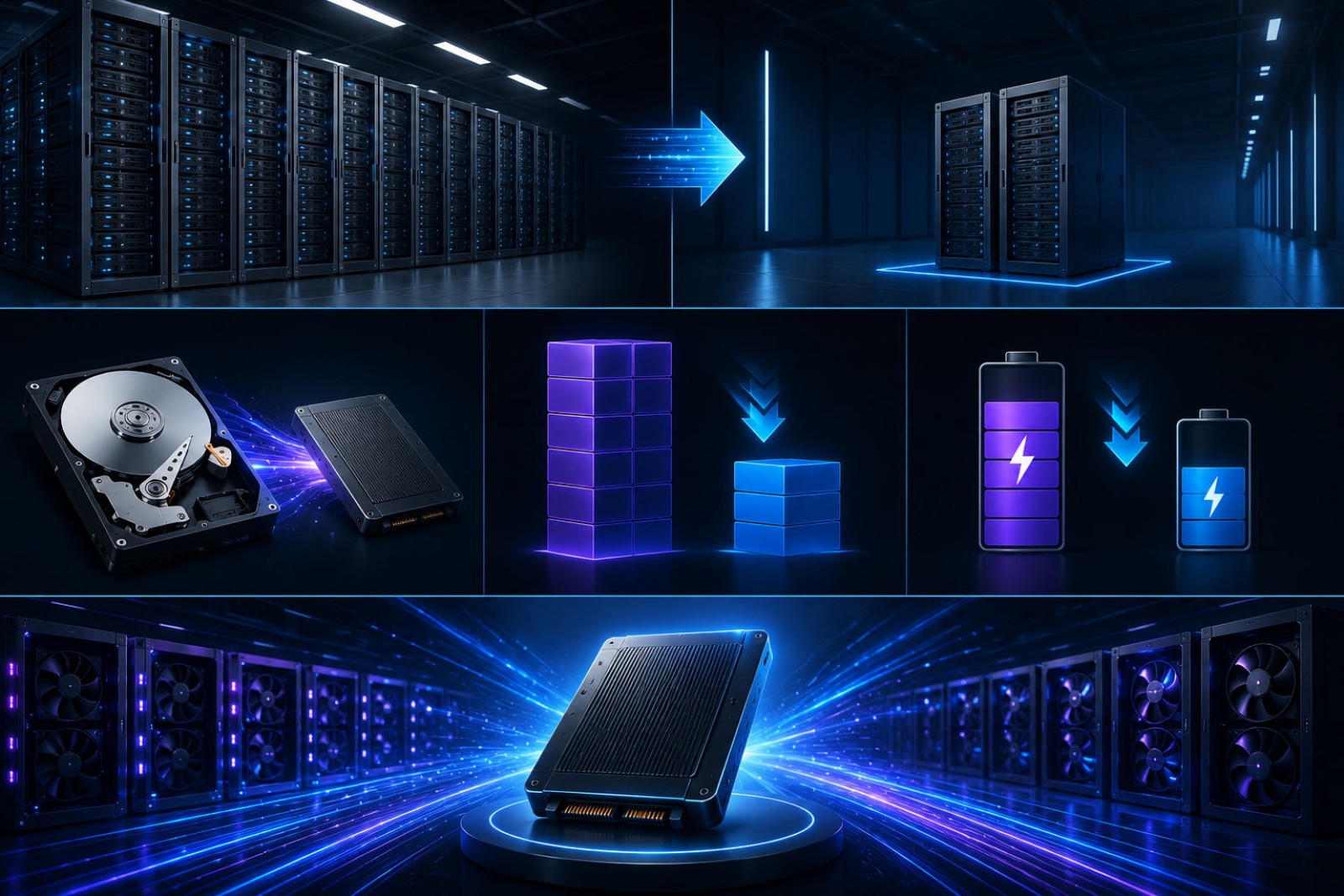
Micron Technology has officially started shipping its new 245TB SSD, currently the highest-capacity solid state drive commercially available. On paper, the announcement looks like another enterprise hardware milestone focused on AI infrastructure and hyperscale storage.
But the bigger story may be what this product quietly threatens to replace.
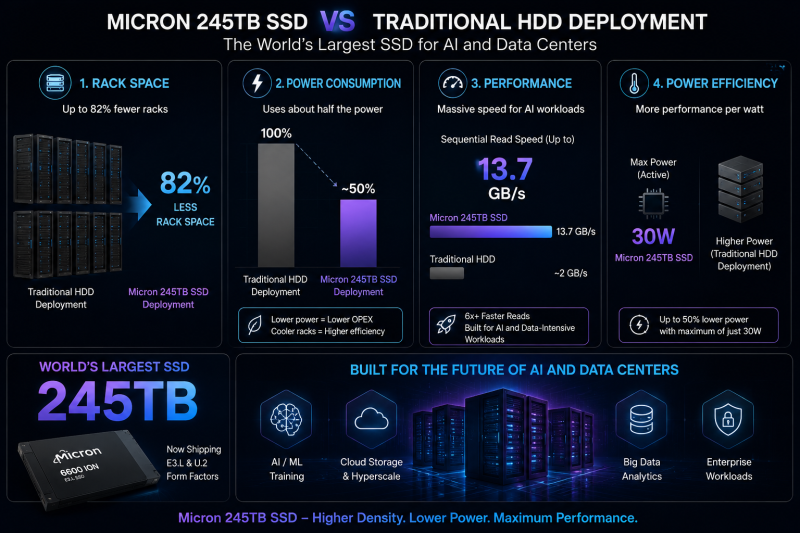
For years, traditional hard disk drives remained dominant in large-scale storage because they were dramatically cheaper than SSDs at high capacities. That tradeoff may now be starting to break down. Micron says its new drive can reduce rack space by up to 82% while consuming roughly half the power of legacy HDD-based systems, all while delivering read speeds up to 13.7 GB/s.
Those numbers matter far beyond storage performance.
The AI boom is creating a new infrastructure bottleneck inside data centers. Training and inference systems increasingly require extremely fast access to massive datasets, and older hard drive architectures struggle to keep up with the throughput demands of modern AI workloads. In many cases, power consumption and physical space are becoming more valuable than raw storage cost itself.
That shift could fundamentally change how hyperscalers think about infrastructure spending.
Instead of optimizing purely for cheap capacity, companies operating AI clusters may increasingly prioritize density, energy efficiency, and data retrieval speed. A single ultra-dense SSD capable of replacing large HDD arrays could lower cooling costs, simplify deployment, reduce hardware complexity, and improve overall AI system utilization rates.
Ironically, the rise of AI may accelerate the decline of the very storage industry that once powered cloud expansion.
Traditional hard drive manufacturers have long argued that HDDs would remain essential because SSD pricing could never scale efficiently to exabyte-level deployments. But AI economics may be rewriting that equation. If GPU clusters costing billions of dollars sit idle waiting for slower storage systems, even extremely expensive SSD deployments may suddenly become financially rational.
The most contrarian implication is that storage itself could become a strategic AI performance layer rather than a passive infrastructure component.
Micron’s 245TB SSD may therefore represent more than a record-breaking drive. It could be an early signal that future AI data centers will look radically different from the cloud infrastructure architecture built over the past two decades.
And if hyperscalers begin prioritizing AI efficiency over raw storage cost, the long-predicted death of the hard drive market may arrive much faster than expected.
 Saad Ullah