Marina Lyubimova

⬤ Euro area inflation climbed to 1.9% in February 2026, edging closer to the European Central Bank's 2% target. The reading signals a modest pickup in price growth, with the euro area aggregate standing out clearly against the broader EU backdrop. Full details are covered in the Euro Area Inflation Rises to 1.9% in February 2026, Flash Estimate.
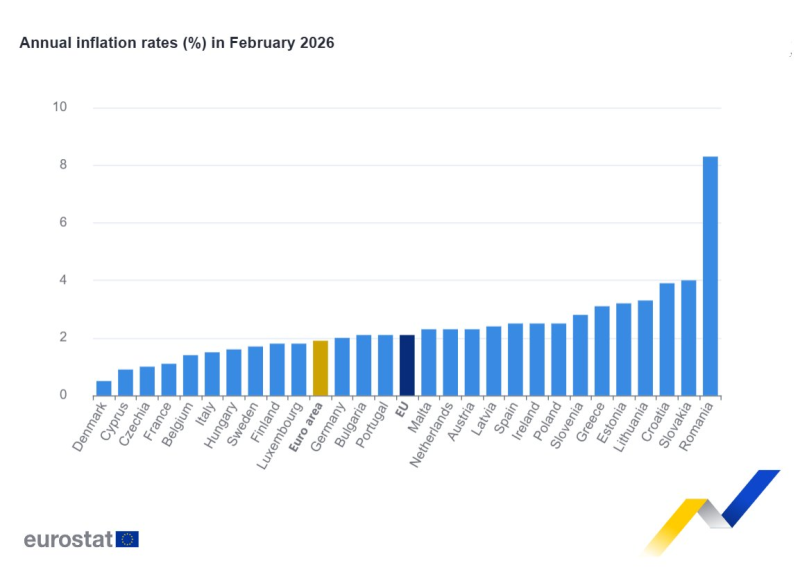
⬤ The data exposes a striking split across EU member states. Denmark and Cyprus remain below 1%, reflecting weak demand-side pressure, while Germany and France track near the euro area average. Spain, Ireland, and the Netherlands have crossed above 2%, pointing to uneven inflation dynamics across the bloc.
The variation across member states suggests that underlying inflation pressures remain uneven, which may continue to influence broader economic conditions and policy expectations.
⬤ Eastern European economies sit at the far end of the scale. Romania tops the chart at above 8%, while Slovakia, Croatia, and Lithuania cluster around 3% to 4%. The February uptick was driven mainly by services and food, with energy still pulling year-on-year figures down. Market reaction is tracked in ECB Rate Expectations Surge as Inflation Moves Toward Target.
⬤ With euro area inflation stabilizing near target, the ECB faces a complex picture: headline figures look controlled, but wide divergence across 27 economies complicates a one-size-fits-all policy stance. Bond market dynamics tied to this story are explored in France vs. Italy: Historic 10-Year Yield Spread Inversion.
 Marina Lyubimova