Sergey Diakov

Ethereum has seen its share of the global DeFi market decline from 63.5% to 54% since the start of 2026, signaling a gradual shift in how liquidity is spreading across the crypto ecosystem.
Despite the drop, Ethereum remains overwhelmingly dominant with roughly $45.4 billion in total value locked (TVL), maintaining more than half of the entire DeFi market.
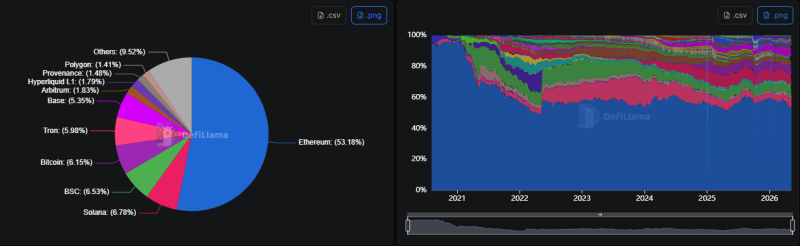
Caption: Ethereum’s share of total DeFi TVL has steadily declined over time, although the network still controls more than half of the market.
Solana currently ranks second with just 6.66% market share, highlighting how fragmented the rest of the sector remains even as competitors slowly gain traction.
The decline in Ethereum’s dominance does not necessarily indicate weakness in absolute terms. Instead, it reflects accelerating growth across alternative ecosystems offering lower fees, faster settlement speeds, and increasingly active retail trading environments.
Much of that momentum has recently flowed into Solana-based applications, particularly in memecoins, decentralized exchanges, and high-frequency on-chain trading activity. Meanwhile, newer Layer-1 and Layer-2 ecosystems continue competing for liquidity as DeFi expands beyond its Ethereum-centric roots.
Still, Ethereum’s lead remains massive.
The network continues to dominate institutional DeFi activity, stablecoin infrastructure, tokenized assets, and large-scale smart contract deployment. Many of the crypto industry’s largest protocols and liquidity pools remain deeply tied to Ethereum’s ecosystem despite growing multi-chain adoption trends.
The latest figures may therefore signal an important transition phase for DeFi rather than a collapse in Ethereum’s position: the market is becoming broader, but Ethereum still remains the center of gravity.
 Sergey Diakov