Marina Lyubimova

There is a widening divide between official optimism and real-time economic data. US Treasury Secretary Scott Bessent recently stated that the American economy could achieve between 4% and 5% real GDP growth in 2026 - a projection that sits well above what current tracking models and Wall Street forecasts are showing. For investors watching the S&P 500 and the broader macro outlook, the gap between political targets and live estimates is hard to ignore.
According to the Atlanta Federal Reserve's GDPNow model, the latest estimate for US real GDP growth in Q1 2026 stands at 2.1%, based on the update released on March 6, 2026. That figure had previously hovered around 3% earlier in the quarter before declining sharply, placing it near the lower end of projections from major forecasters.
GDPNow at 2.1%: What the Real-Time Data Is Saying
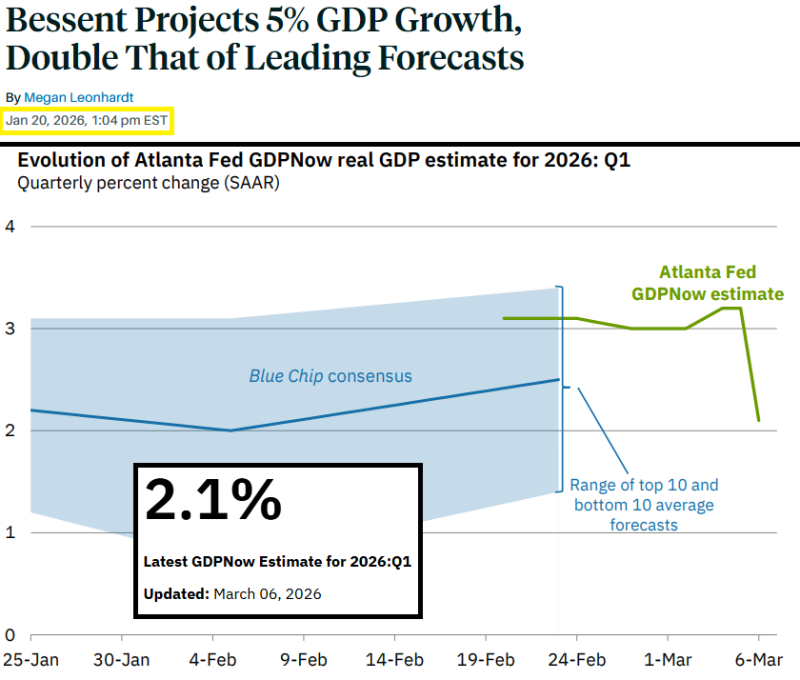
The GDPNow model is closely followed by macro analysts precisely because it responds to incoming data as it arrives - no smoothing, no assumptions, just numbers. The Blue Chip consensus, which aggregates projections from leading economists, places expected 2026 growth between roughly 1% and just above 3%. Most Wall Street forecasts cluster in the 2% to 3% range, reflecting expectations of steady but moderate expansion rather than anything resembling a breakout year.
The projection stands well above current real-time economic estimates.
Against that backdrop, Bessent's 4% to 5% target looks considerably more ambitious. Whether it reflects genuine policy confidence or serves as an aspirational benchmark remains an open question - but the distance between it and live tracking models is notable either way.
Why the GDP Forecast Gap Could Matter for Markets in 2026
Growth expectations do not stay in the background for long. They feed into interest rate expectations, equity valuations, and overall macro sentiment. If incoming economic data starts moving closer to the stronger growth scenario - driven by factors like fiscal spending, labor market resilience, or a pickup in business investment - markets would likely reprice accordingly. Goldman Sachs has projected a 2.9% growth rebound for the US, which is more measured than Bessent's target but still above the current GDPNow read.
For now, the 2.1% GDPNow estimate and the 4% to 5% official outlook paint two very different pictures of where the US economy is headed. The data will ultimately decide which one proves closer to reality - and markets will be watching every update closely.
 Marina Lyubimova