Artem Voloskovets

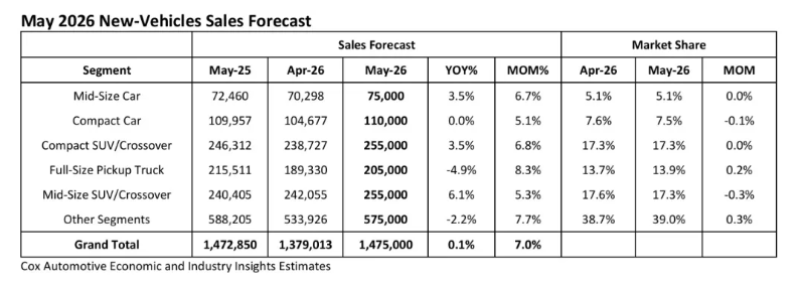
Ford sold fewer vehicles in May. The U.S. market didn't. Cox Automotive estimates report, total U.S. new-vehicle sales reached roughly 1.475 million units in May, essentially flat from a year earlier (+0.1% YoY). Ford, meanwhile, reported a 13.6% decline in U.S. sales. That gap is difficult to ignore.
The broader market showed signs of resilience. Compact SUVs and crossovers were expected to rise 3.5% year-over-year to 255,000 units, while mid-size SUVs were projected to increase 6.1% to 255,000 vehicles. Even with affordability concerns and elevated financing costs, consumers continued buying.
Ford's report tells a different story. The company delivered 178,667 vehicles in April, down from 208,675 a year earlier. Year-to-date sales have fallen 10.4%, from 709,966 vehicles to 635,982. The weakness is increasingly concentrated in categories that Ford has spent years positioning as growth drivers.
EV Momentum Continues to Fade
Electric vehicle sales dropped 31.1% year-over-year. Year-to-date EV deliveries have fallen even further, down 33.8%. The most striking figure came from the F-150 Lightning. Sales of Ford's flagship electric pickup declined 49.2%, with year-to-date deliveries down nearly 67%. Mustang Mach-E sales also remain well below last year's levels, falling 8.8% in April and 50% year-to-date.
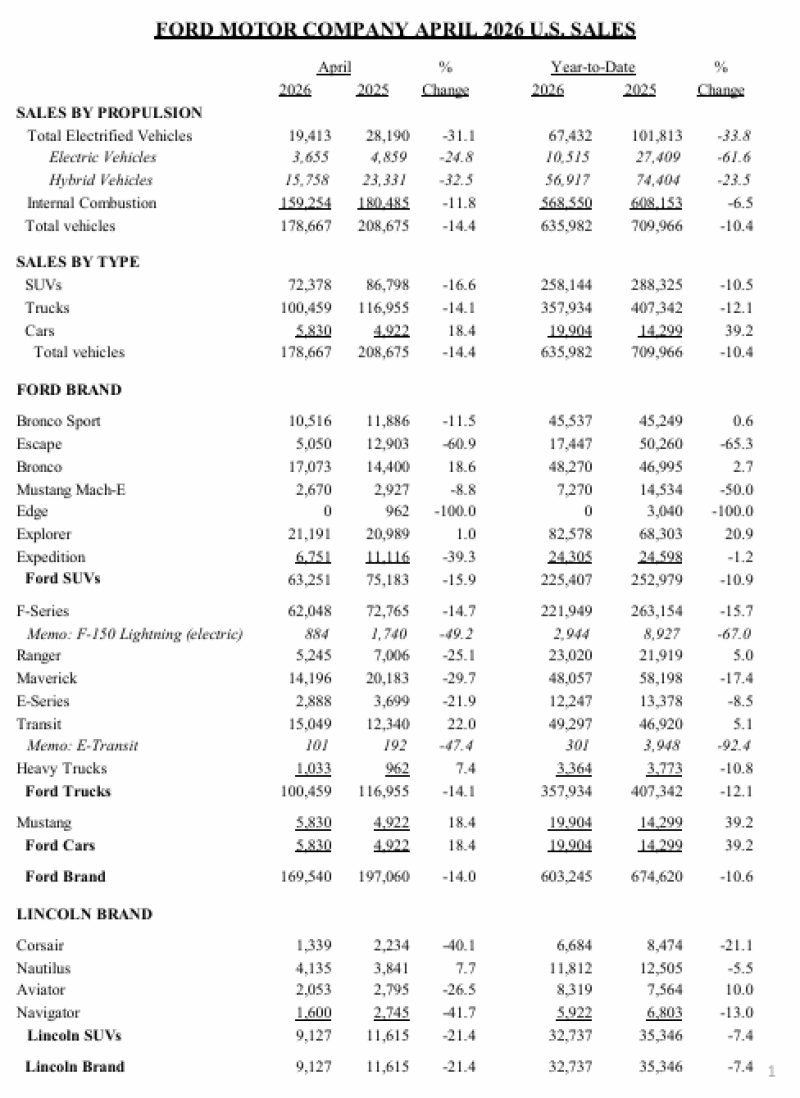
Ford's EV business remains under pressure, led by a sharp decline in F-150 Lightning sales.
The numbers stand out because EVs were supposed to become an increasingly important part of Ford's growth story. Instead, they are becoming a drag on overall volume. The broader U.S. EV market has slowed compared to the peak growth years, but Ford's decline significantly exceeds the industry's pace.
SUVs Are No Longer Offsetting Weakness Elsewhere
Ford's SUV lineup delivered some of the largest declines in the report. Total Ford SUV sales fell 15.9%.
Several key models posted particularly steep drops:
- Escape: -60.9%
- Expedition: -39.3%
- Bronco Sport: -11.5%
Not every vehicle struggled. Bronco sales increased 18.6%, while Explorer was roughly flat. The issue is that the winners are no longer large enough to compensate for the losers.
Sharp declines in Escape and Expedition outweighed gains from Bronco and stability in Explorer.
SUVs remain one of the industry's most profitable categories. Weakness across multiple nameplates matters far more than a single disappointing month in a niche segment.
The Market Is Still Buying Trucks
One reason the report stands out is that demand for trucks remains relatively healthy across the industry. Cox Automotive estimates show full-size pickup sales near 205,000 units in May, representing almost 14% of the entire U.S. market. Ford's truck business, however, moved in the opposite direction.
Ford truck sales fell 14.1%, while F-Series deliveries declined 14.7%. The decline extends beyond EVs and into the company's most important profit center. When weakness appears simultaneously in EVs, SUVs, and trucks, it becomes harder to attribute the results to a single product cycle or temporary disruption.
A Difficult Environment Is Emerging for Automakers
Ford's sales report arrives as the global automotive sector faces a less favorable operating environment. European officials recently warned that rising energy costs could threaten hundreds of thousands of automotive jobs across the region. Higher manufacturing costs are becoming a growing concern at the same time that vehicle demand is becoming less predictable.
Weak demand can be managed. Rising costs can be managed. Both at the same time usually lead to pressure on margins.
Ford's May numbers do not point to an industry-wide downturn. U.S. consumers are still buying vehicles, and overall market volumes remain stable. What they do suggest is that Ford's challenges run deeper than the broader market. When industry sales are flat and a major automaker reports a 13.6% decline, the conversation shifts away from the consumer and toward the company itself. The market is holding up. Ford isn't.
 Artem Voloskovets