
 Usman Salis

A dramatic shift in global oil logistics is unfolding as Saudi Arabia ramps up exports through its Red Sea corridor. As The Kobeissi Letter noted, crude shipments from Yanbu have surged to roughly 5 million barrels per day, doubling in just two weeks. The chart confirms this acceleration, with export volumes steadily climbing through March and reaching peak levels at month-end - a clear signal of sustained rerouting rather than a temporary spike.
The Yanbu Ramp That Redefined Saudi Oil Flow Direction
The chart shows a consistent upward trajectory in total exports from Yanbu, rising from roughly 2 million barrels per day in early March to nearly 5 million by March 29. This progression is marked by consecutive higher bars - a structured and sustained increase rather than volatility-driven swings.
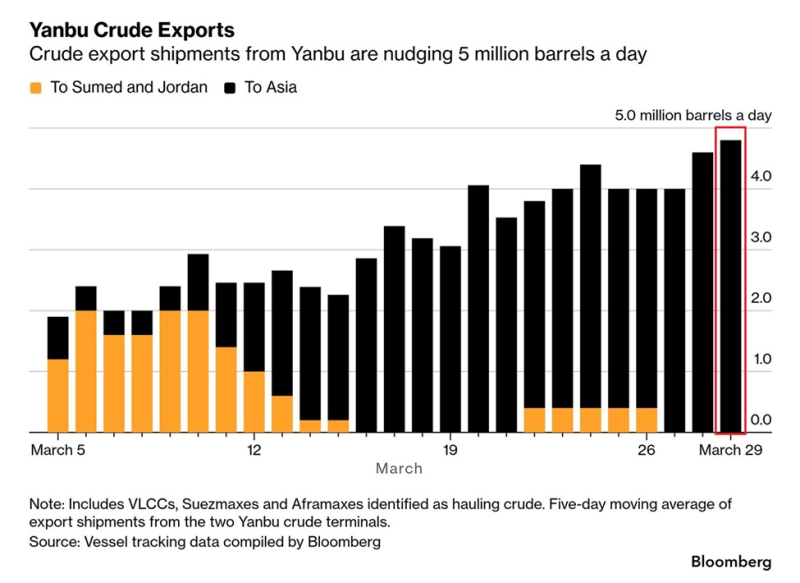
A notable shift occurs mid-month: early flows include visible shipments to Sumed and Jordan, but as volumes increase, exports to Asia dominate the structure. By the final week, nearly all shipments are directed toward Asian markets - signaling a decisive rerouting of supply away from disrupted Gulf routes.
By the final week of March, nearly all Yanbu shipments are directed toward Asian markets - a decisive rerouting rather than a temporary adjustment.
Saudi Exports Surge to 4.19M bpd as Yanbu Rerouting Bypasses Hormuz captured the earlier stage of this rerouting, providing a baseline for just how rapidly flows have continued to accelerate beyond that initial reading.
A Saudi Oil System Scaling Toward Capacity
The upper range of the chart - clustered near 4 to 5 million barrels per day - reflects a system operating close to its new ceiling. The steady climb and stabilization at elevated levels suggest that infrastructure is not only absorbing the shift but sustaining it. The absence of sharp pullbacks indicates that flows are being maintained consistently once capacity is reached.
The steady climb and stabilization at elevated levels suggest infrastructure is not only absorbing the shift but sustaining it - flows are being maintained consistently once capacity is reached.
WTI Tops $96 and Brent Nears $111 as Hormuz Tanker Traffic Collapses to Near Zero shows the price consequences of the disruption that triggered this rerouting - and why maintaining Yanbu flows at peak capacity has become critical to preventing further oil market dislocation.
Where Saudi Oil Stability Meets Constraint
The final bars near the 5 million mark reinforce how quickly the doubling occurred. At the same time, the chart structure highlights a tightly balanced system:
- A clear uptrend with no meaningful retracement
- Consolidation near peak output levels
- Increasing concentration of flows toward a single destination
While this rerouting has offset a significant portion of disrupted shipments, it also concentrates supply through fewer channels. The chart reflects resilience - but also shows how close the system is operating to its limits.
The result is a market that has adjusted faster than most expected, but where that adjustment itself introduces a new kind of fragility. Sustained high-capacity flows through Yanbu are no longer a contingency - they have become the foundation of global oil supply stability.
 Usman Salis



