
 Usman Salis
India gold demand has entered a new phase as investment buying overtook jewelry consumption for the first time in Q1 2026, signaling a deeper transformation in one of the world’s largest gold markets. The shift comes amid sharply rising prices and changing buyer behavior, with investors increasingly favoring liquid forms of gold over traditional purchases. While the headline milestone has drawn attention, the underlying data suggests a more structural change in how demand is formed and sustained.
The Turning Point in India Gold Demand
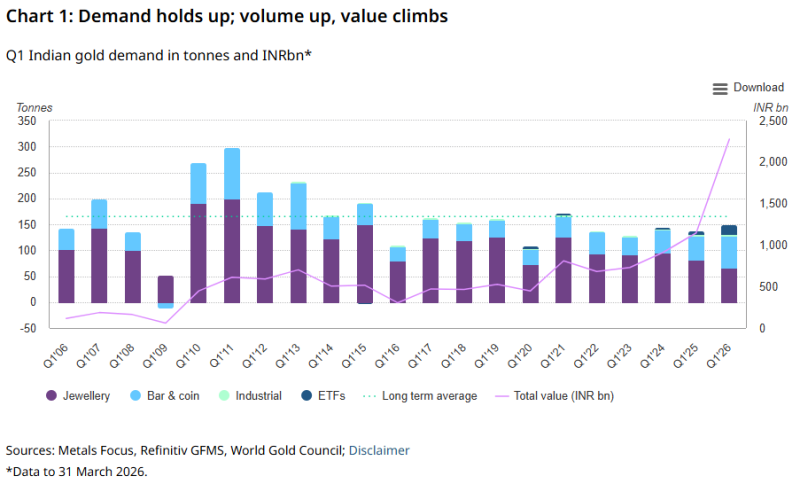
In Q1 2026, investment demand climbed to 82 tonnes, surpassing 66 tonnes of jewelry consumption, marking a historic shift. Total demand held at 151 tonnes, indicating that the market is not shrinking, but transforming internally - from consumption-driven to investment-led.
Reason 1:
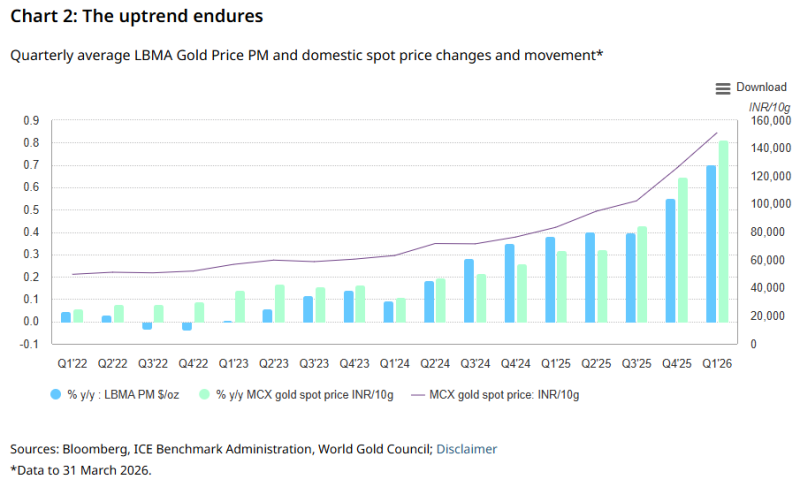
Prices Changed the Rules of the Market The primary driver behind this shift is price. Domestic gold prices surged to around INR 150,000+ per 10 grams, with year-on-year growth approaching 80%. This sharp increase has fundamentally altered affordability. As prices rise, traditional jewelry purchases become less accessible, forcing buyers to adjust.
This shift is consistent with the broader trend of gold’s parabolic rally, where sustained price growth is changing how gold is perceived - from a consumption good to a financial asset.
Reason 2:
Investment Demand Became a Substitute Investment demand — including approximately 62 tonnes in bars and coins and about 20 tonnes in ETFs - is not simply additional demand. It is replacing jewelry consumption.
This substitution effect is critical. It shows that India gold demand is becoming more adaptive: instead of exiting the market under price pressure, buyers are reallocating within it. This is a key signal of market maturity and financialization.
Reason 3:
Liquidity Is Now a Priority Another major factor is liquidity. Jewelry locks capital and includes additional costs such as making charges. In contrast, bars, coins, and ETFs offer flexibility and can be easily liquidated.
In the current macro environment, this flexibility is increasingly valuable. The rise in investment demand aligns with stronger safe-haven demand, as investors prioritize assets that can respond quickly to uncertainty.
Reason 4:
A Persistent Price Trend Reinforces Investment Behavior The shift is not driven by short-term volatility, but by a sustained price trend. Both global (LBMA) and domestic (MCX) prices have shown a consistent upward trajectory since 2022, with acceleration into 2025–2026.
This kind of trend encourages momentum-driven behavior. Buyers are no longer purchasing gold solely for long-term holding, but increasingly for capital preservation and potential upside.
How This Shift Could Reshape the Gold Market
This transformation has important global implications. Jewelry demand has traditionally been stable and seasonal, acting as a buffer in the gold market. Investment demand, however, is more reactive and sensitive to macroeconomic signals.
As India gold demand becomes more investment-driven, its role may shift from stabilizing the market to amplifying price movements - increasing overall volatility.
Conclusion
India gold demand is undergoing a structural transformation. With 82 tonnes in investment demand versus 66 tonnes in jewelry, the market is becoming more price-driven, more liquid, and more financially oriented. This turning point is not just a statistical milestone - it marks a fundamental change in how gold is used and valued in one of the world’s most important markets.
 Usman Salis



