Eseandre Mordi

⬤ New data from RBC Economics makes one thing clear: not everyone feels a gas price hike the same way. An analysis by RBC economist Michael Reid breaks down gasoline spending as a share of total annual expenditures across income groups in 2024 - and the gap is striking. Lower and middle-income households are far more exposed to rising fuel costs, simply because gas takes up a much bigger piece of their budgets.
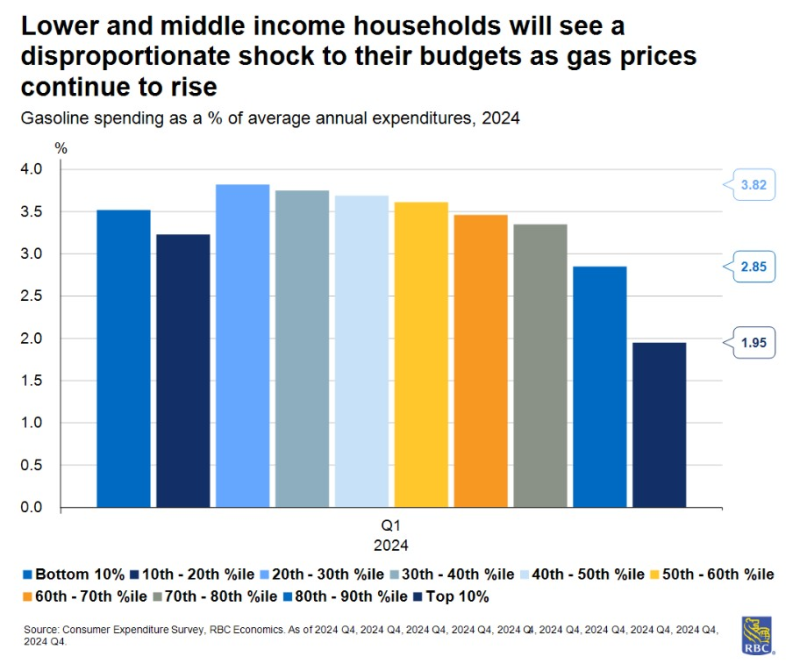
⬤ Households in the bottom income brackets spend roughly 3.3% to 3.8% of their annual budgets on gasoline. The hardest-hit group sits in the 20th-30th income percentile, where fuel accounts for about 3.82% of total expenditures. Several other lower- and middle-income groups are already dealing with record consumer debt, and a fuel spike lands directly on top of that pressure. When gas gets expensive, it doesn't just sting - it reshapes how these households spend on everything else.
Lower-income households allocate nearly twice the share of their budgets to gasoline compared to the top 10% - making every price spike a disproportionate financial shock. - Michael Reid, RBC Economics
⬤ Wealthier households tell a very different story. Those in the 80th-90th income percentile spend around 2.85% of their budgets on gas, while the top 10% spend just 1.95%. That's less than half the share absorbed by the most vulnerable income group. Global inflation signals remain mixed, but domestically, fuel costs continue to act as a regressive tax - hitting hardest those who can least afford it.
⬤ The broader takeaway is that gasoline prices aren't just a number at the pump - they're a lever that affects purchasing power, spending patterns, and financial stability in ways that play out very differently depending on income. As real-time inflation trackers diverge sharply from official CPI figures, the lived experience of rising costs for lower-income households may be considerably more severe than headline data suggests.
 Eseandre Mordi