
 Marina Lyubimova

Samsung has delivered a historic earnings signal, with its preliminary Q1 2026 operating profit not only surging year-over-year but exceeding its full-year 2025 result. As Bernt Berg-Nielsen noted, the scale of the increase reflects a powerful shift in demand tied to AI-driven memory chips.
A Samsung Quarter That Breaks the Historical Range
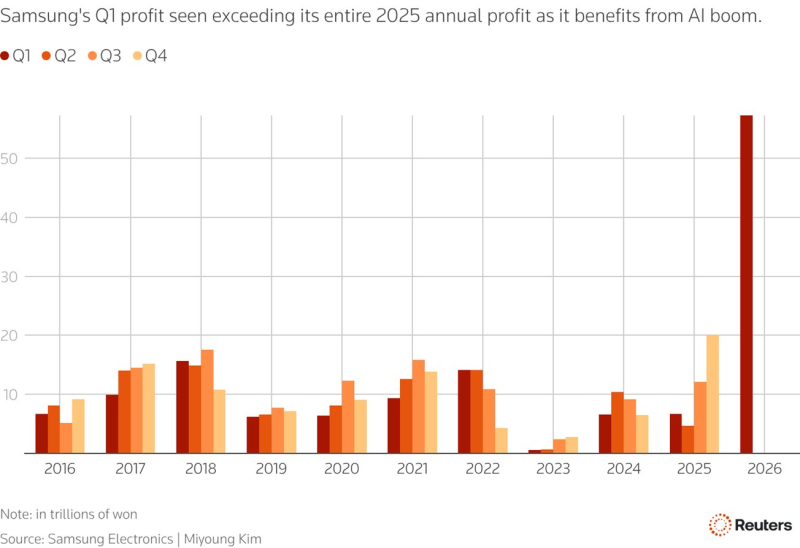
The chart shows quarterly operating profit trends from 2016 through 2026, with relatively stable cycles until a sharp breakout appears in early 2026. Previous peaks - such as 2017-2018 and 2021 - generally ranged between 10 and 20 trillion won per quarter.
Q1 2026 reaching 55-60 trillion won is not a cyclical upswing - it is a structural break that takes Samsung's earnings into an entirely new range.
In contrast, Q1 2026 stands out dramatically, reaching roughly 55-60 trillion won. This reflects a clear structural break rather than a typical cyclical upswing - the kind of move that changes how analysts frame the entire earnings trajectory going forward.
Samsung Growth That Overtakes an Entire Year
The most striking feature is that Q1 2026 alone surpasses Samsung's full-year 2025 operating profit. The chart visually reinforces this, with 2025 quarterly bars remaining relatively modest compared to the outsized Q1 spike. The tweet specifies a 755% year-over-year increase driven by AI-related demand for memory chips alongside rising chip prices - a combination that explains both the magnitude and the speed of the jump.
Samsung Could Be World's Most Profitable Company by 2027, With $240.6B Operating Profit laid out the longer-term trajectory that Q1 2026 is now accelerating - and a single quarter surpassing the full prior year makes that 2027 projection look increasingly plausible.
The Scale Behind Samsung's AI Memory Chip Surge
The source highlights several key factors behind the surge that distinguish it from prior cycles where growth was more gradual:
- Increased demand for AI-related memory chips
- Rising memory chip prices
- Strong revenue growth supporting margins
These elements align with the sharp vertical expansion in Q1, distinguishing it from prior cycles where growth was more gradual and cyclical rather than structurally driven.
KOSPI Jumps 175% as Samsung and SK Hynix Fuel Korea's Fastest 1,000-Point Move in History shows how Samsung's earnings momentum is already reshaping broader market dynamics in Korea - with the stock's performance pulling the entire index into historically fast territory.
A Shift in Samsung's Earnings Structure
The chart reflects a transition from cyclical fluctuations to a more explosive growth phase. Earlier years show oscillating quarterly performance, but the latest data point introduces a new range far above historical norms. Samsung's Texas Fab Nears $16.5B AI Chip Production as 7,000 Workers Push for 2nm Launch reinforces that the capacity investments needed to sustain this kind of output are already underway - meaning the Q1 result may be a floor rather than a ceiling if AI memory demand continues to scale.
Samsung's earnings are no longer moving within historical ranges. They are breaking into a new phase defined entirely by the scale of AI-driven demand - and Q1 2026 is the clearest evidence yet that the shift is structural, not cyclical.
 Marina Lyubimova



