Usman Salis
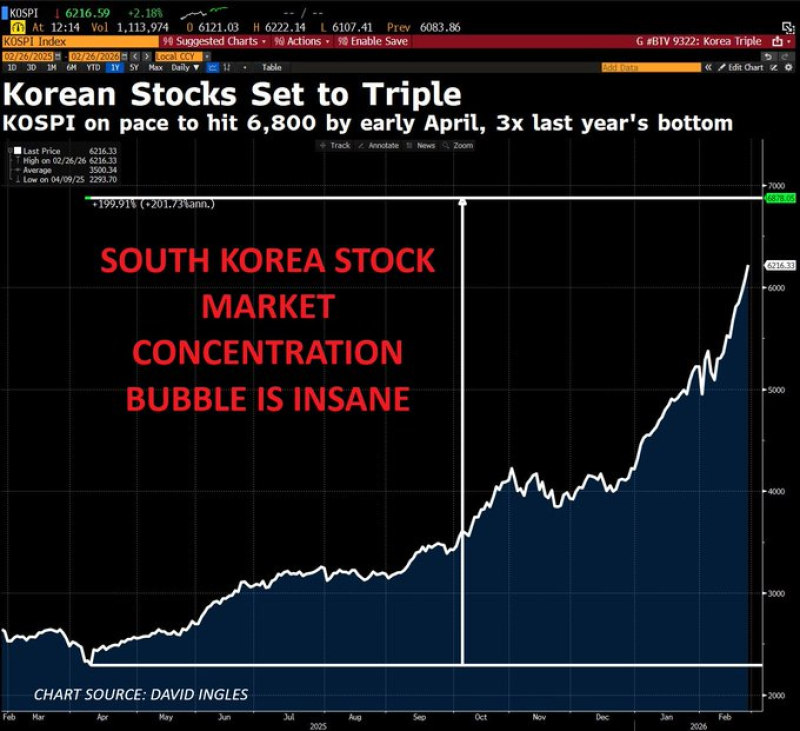
South Korean stocks have been on a tear. The KOSPI index recently crossed 6,200 and is now tracking toward a potential 6,800 target by early April — a move that, if it happens, would represent a near-tripling from last year's bottom. What makes this rally remarkable isn't just the size of it, but the sheer speed. The index went from 5,000 to 6,000 in fewer than 40 days, the fastest 1,000-point climb in KOSPI history. As of the latest session, the index was sitting near 6,216, up about 2.18% on the day.
Samsung Up 70%, SK Hynix Up 62% — 2 Stocks Driving 98% of KOSPI 200 Profit Growth
The rally hasn't been broad-based. It has been driven almost entirely by two names: Samsung Electronics, up roughly 70% year to date, and SK Hynix, up about 62%. Together, these two chipmakers represent around 40% of the entire KOSPI index — and according to current estimates, they are responsible for nearly 98% of projected profit growth for KOSPI 200 companies, as well as roughly 50% of the index's total rise. That's an extraordinary concentration of influence, and it cuts both ways.
The index jumped from 5,000 to 6,000 in less than 40 days — the fastest 1,000-point move in its history.
When these stocks move up, the index surges. When sentiment shifts, the damage can be just as fast. BofA has already flagged "bubble-like" behavior in the KOSPI, pointing to the same dynamics.
AI Chip Demand Is the Engine Behind Korea's Market Surge
The catalyst behind all of this is AI. Demand for memory chips — the kind that power large language models and AI infrastructure — has been surging, and Samsung and SK Hynix sit at the center of that supply chain. Record earnings expectations for both companies have given investors a concrete reason to buy, and the momentum has fed on itself. Hedge funds have piled into semiconductor exposure at record levels, amplifying the move. Meanwhile, Samsung's AI chip production push — including its Texas fab targeting 2nm production — signals that the company is positioning for sustained demand rather than a short-term spike.
The broader takeaway is straightforward: when a dominant theme like AI-linked chip demand aligns with extreme index concentration, benchmark performance becomes hypersensitive to a handful of stocks. The KOSPI's 175% rally is a compelling story, but the same setup that powered the move could just as easily reverse it if the earnings cycle or macro backdrop shifts.
 Usman Salis