Usman Salis
⬤ Samsung Electronics may become the most profitable company in the world by 2027. That's the takeaway, which shows Samsung leading a list of the world's biggest tech firms in projected operating profit - even as its market cap stays under the $1 trillion mark.
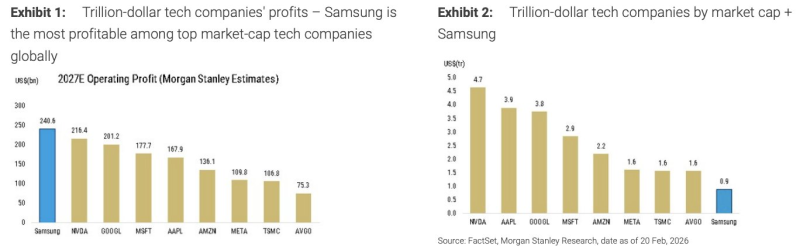
⬤ Morgan Stanley's data (Exhibit 1) puts Samsung's 2027 operating profit at roughly $240.6 billion - ahead of NVDA, GOOGL, MSFT, AAPL, AMZN, META, TSMC, and AVGO. The numbers reflect strong expectations for Samsung's semiconductor and memory divisions, which are set to benefit from AI-driven chip demand in the years ahead.
By 2027, Samsung could generate more operating profit than any other company on the planet - yet the market still values it below a trillion dollars.
⬤ Exhibit 2 tells a different story. While U.S. tech giants are comfortably above the $1 trillion valuation threshold, Samsung sits at around $0.9 trillion. That's a big gap between what the company is expected to earn and what the market is currently willing to pay for it. This kind of divergence isn't unique to Samsung - we've seen similar dynamics play out across major tech names. NVDA Price Holds $174 as Retail Inflows Surge, Market Cap at $4.24T showed how retail flows can support valuations even amid uncertainty, while NVDA Stock Above $190, Becomes First $4.6 Trillion Company illustrated how fast sentiment can reprice a stock when momentum aligns. Meanwhile, AAPL Market Cap Holds Near $3.9T Despite Earnings Volatility is another reminder that profit and valuation don't always move together.
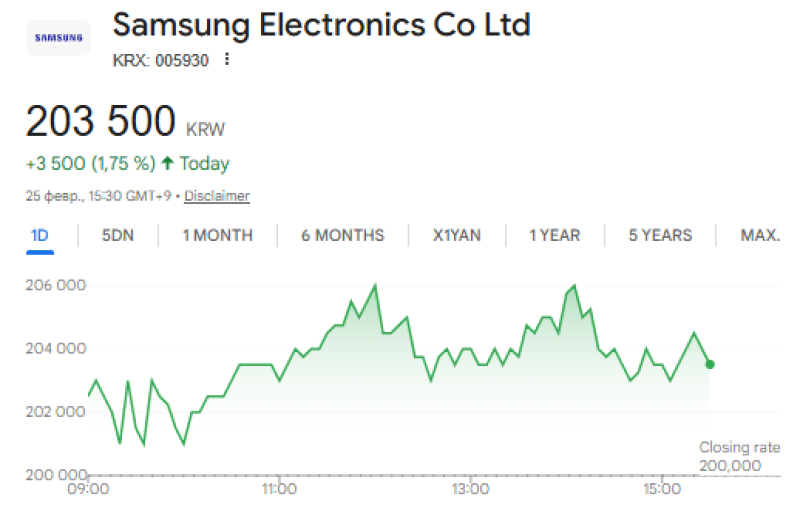
⬤ If Samsung's profit outlook holds, 2027 could reshape the global corporate hierarchy in a meaningful way. Growth narratives, geographic exposure, and how investors weigh geopolitical risk all play into why a company earning $240 billion can still trade below a trillion. The Samsung story is really a question about whether markets will eventually close that gap - or keep discounting it.
 Usman Salis