Eseandre Mordi
For the past two years, Nvidia has been one of the most talked-about stocks on Wall Street. Its meteoric rise on the back of AI-driven chip demand turned it into a market darling, with revenue growth rates that seemed almost too good to be true. Now, as the latest earnings cycle wraps up, the story is entering a new chapter — one defined not by explosive acceleration, but by the question of what sustainable growth looks like after the peak.
Nvidia Revenue Jumped From Under $1B to $4B+ Before Growth Began to Slow
Nvidia Corporation is trading near flat after its latest earnings release as the market digests a notable shift in its growth trajectory. The company's top-line growth rate once peaked above 200%, but has since moderated into the mid-60% range — a cooldown that's drawing attention from analysts and retail investors alike.
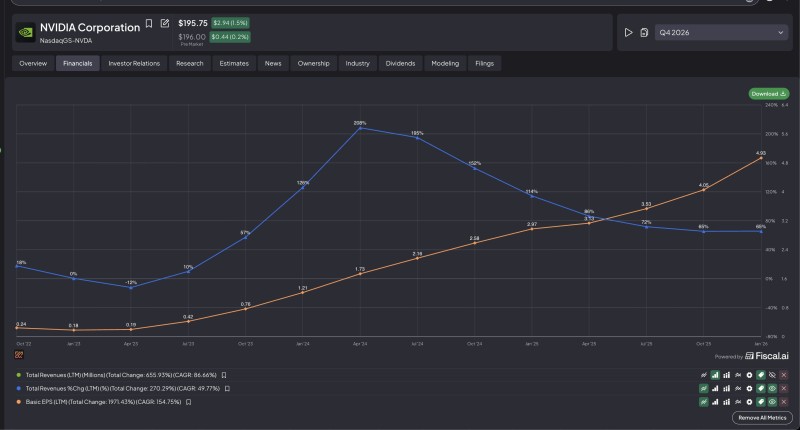
The numbers tell a compelling story. Total revenues climbed sharply from under $1 billion to above $4 billion over recent trailing periods. But as that base expanded, sustaining triple-digit percentage growth became mathematically harder. This is the law of large numbers at work — and Nvidia is not immune to it. The growth comparison now runs against a much higher benchmark than in the company's early rally stages.
AI Demand Stays Strong, But Capital Cycles and Infrastructure Limits Now Matter
Demand for AI hardware remains robust, yet Nvidia's hardware-driven model carries structural constraints that pure software businesses don't face. Customers must navigate capital expenditure cycles, component availability, credit conditions and data center infrastructure limits — all of which naturally moderate deployment speed. This context was explored in detail in NVDA stock price under pressure as insiders sell ahead of earnings, where valuation and growth sustainability were central themes.
Heightened volatility around earnings expectations has also played a role. Coverage of NVDA stock drops amid surge in options trading reflected how quickly sentiment can swing when growth benchmarks shift. Meanwhile, NVDA stock bounces off support before critical trading day showed that even during growth normalization, price action can find stable footing.
For investors, the focus is shifting away from peak percentage gains toward what matters next: durability of earnings, infrastructure capacity and long-term AI demand trends that will define Nvidia's next cycle. The moderation in growth does not imply weakening fundamentals — it signals a transition from hyper-expansion toward a more measured and arguably more sustainable phase.
 Eseandre Mordi