Alex Dudov
Microsoft is doing something that most companies only dream about: growing its profits far faster than its costs. Operating income climbed from roughly $64 billion in 2021 to around $142 billion by late 2025, while operating expenses moved from about $46 billion to $67 billion over the same stretch. That widening gap tells a straightforward story about a business that has genuinely scaled. Microsoft shares have pulled back close to 18% over the past six months, with the stock trading near the $400 level, which has reopened a serious conversation about whether current valuations reflect the company's long-term trajectory.
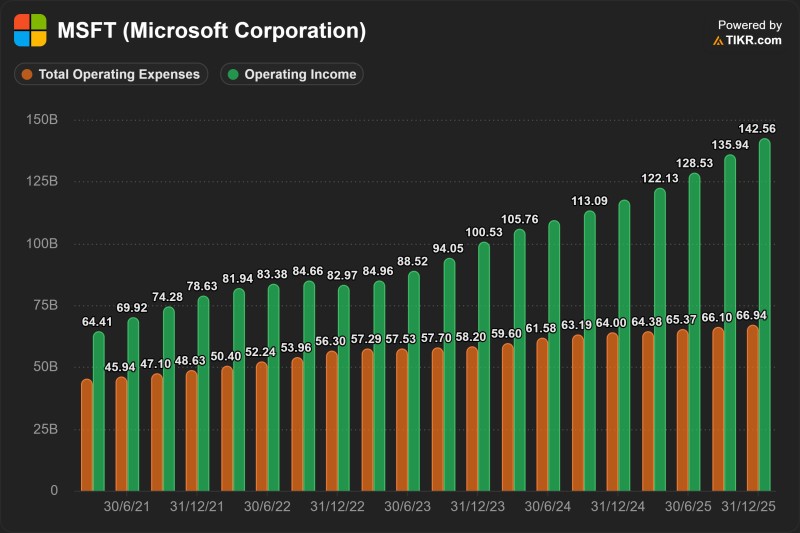
MSFT Fundamentals: A Widening Profitability Gap Backed by Azure's 40% Growth
The numbers behind MSFT stock extends rally after confirmed bullish setup are not an accident. Microsoft's platform runs deep across corporate infrastructure: Windows, Microsoft 365, Azure cloud services, developer tools, and enterprise security all generate recurring revenue that is difficult for customers to walk away from. That stickiness supports steady income growth even when the broader market gets nervous. Microsoft stock news: Azure growth tops 40% in strong quarter showed just how much demand there is for cloud capacity, with Azure posting around 40% year-over-year growth in a single quarter, reinforcing Microsoft's position at the top of enterprise cloud computing.
AI Infrastructure and Copilot Drive Microsoft's Next Growth Phase
Azure has transformed into a core AI infrastructure platform handling advanced workloads, from machine learning pipelines to large-scale inference systems. Microsoft has been expanding its global data-center footprint to keep up, including facilities designed specifically for high-performance GPU-based computing. On the software side, tools like Microsoft Copilot and GitHub Copilot are moving from pilot programs into standard enterprise workflows, building out a new layer of recurring revenue that sits on top of the existing cloud business. Technical analysts have pointed to this combination of infrastructure depth and software monetization in MSFT stock extends bullish sequence toward $600 target, arguing that Microsoft's long-term structure remains intact despite near-term price weakness.
The broader takeaway is that Microsoft's expanding operating income gives the company room to keep investing heavily in AI while sustaining the kind of earnings profile that long-term investors value. The gap between income and expenses is not just a data point; it is the financial engine that makes large-scale innovation sustainable over time.
 Alex Dudov