Marina Lyubimova

Meta Platforms Inc. (META) may be approaching one of the most significant structural turning points in its trading history. After an extended multi-year bull run that pushed prices well above $800, Elliottwave Forecast analysts are now flagging a potential Grand Super Cycle completion - a rare signal that typically precedes deep, prolonged corrections rather than a quick dip and recovery.
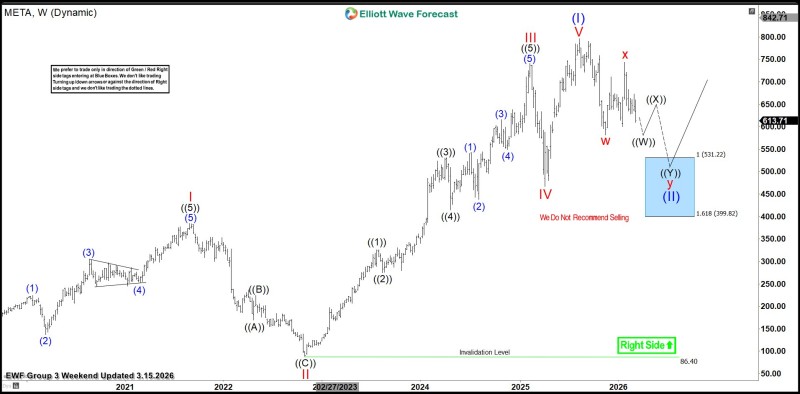
According to META stock sliding toward $577-$547 support zone in a 5-wave decline, the stock has already shown classic bearish sequencing consistent with the early stages of a larger corrective structure.
Elliott Wave Points to a 7-Swing W-X-Y Correction Toward $399-$531
As ElliottForecast recently outlined, the completed five-wave impulsive advance into the wave V peak near $800+ is now giving way to a complex corrective pattern labeled as a W-X-Y structure. This 7-swing sequence projects a corrective range between approximately $531 and $399 - a zone that aligns with standard large-degree retracement targets in Elliott Wave theory.
Intermediate wave subdivisions - ((W)), ((X)), and ((Y)) - suggest the decline will be neither fast nor straight down, but instead a choppy, multi-leg process. META stock rebounds from key Elliott Wave support showed how the stock previously reacted to structured corrective zones, confirming that Elliott Wave levels carry real price significance for META.
Corrective Phase Does Not Signal a Trend Reversal - "Right Side" Label Remains Bullish
Despite the bearish near-term outlook, the broader Elliott Wave chart carries a "Right Side" bullish label at lower levels - meaning the framework does not yet confirm a permanent trend reversal. Analysts explicitly note "We Do Not Recommend Selling," treating the current decline as a structural correction within a larger cycle rather than a breakdown. META stock bounces from Elliott Wave blue box support zone further supports this view, documenting how price stabilized sharply after completing a prior corrective sequence. Once the W-X-Y pattern fully resolves, the longer-term structure may still favor renewed upside.
 Marina Lyubimova