Marina Lyubimova

⬤ New demographic data from Eurostat shows a modest but steady improvement in longevity across the European Union. Life expectancy at birth hit 81.5 years in 2024, up 0.1 years from 2023. The figures point to gradual stabilization in population health after the turbulence of prior years, though the data also reveals deep regional fault lines that persist across the bloc.
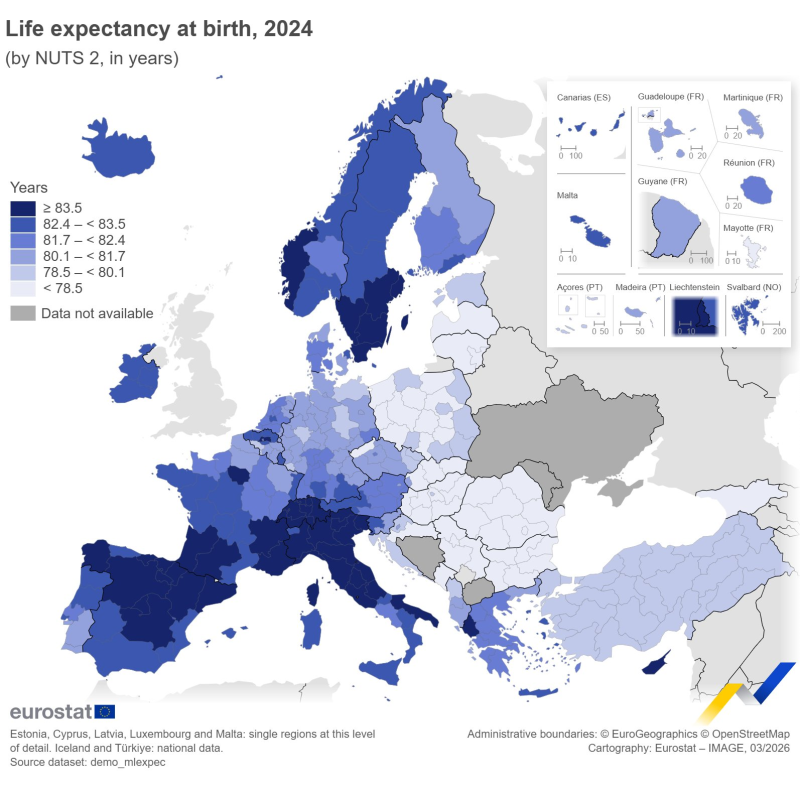
⬤ Broken down by NUTS 2 regional classifications, the map shows Comunidad de Madrid topping the EU with a life expectancy of 85.7 years. Spain, Italy, and parts of France consistently appear among the highest longevity zones, with several regions recording figures above 83.5 years. Southern and western Europe dominate the upper end of the distribution by a considerable margin.
A nearly 12-year gap between the EU's highest and lowest regions reflects not just geography, but decades of divergence in healthcare access and economic conditions.
⬤ On the opposite end, Bulgaria's Severozapaden region recorded the lowest figure at 73.9 years, creating a gap of nearly 12 years with Madrid. Eastern European regions broadly cluster in the lower ranges, reflecting long-standing disparities in healthcare infrastructure, income levels, and preventive care. These differences are not new, but the scale of the gap underscores how uneven health outcomes remain within a single economic bloc.
⬤ Policymakers and economists track life expectancy closely because aging populations carry real fiscal weight, from pension systems to healthcare budgets and labor supply. The EU's demographic pressures are building across multiple fronts. EU's median age has already reached 44.5 years, nearly 15 years above the global average, a trend that will continue to reshape economic planning and social policy across the continent in the years ahead.
 Marina Lyubimova