Saad Ullah
Agriculture is often underestimated as an economic driver across Europe, yet the latest Eurostat data shows just how differently it weighs on individual member states. While the EU-wide figure sits at a modest 1.2% of GDP, the gap between countries like Greece and Luxembourg tells a much bigger story about how diverse European economies really are.
Greece Tops EU Agriculture Rankings at 3.2% of GDP in 2024
The EU's agricultural industry accounted for 1.2% of gross domestic product in 2024, according to figures from EU_Eurostat. The data come with a cross-country chart titled "Gross value added from agriculture, 2009 and 2024," which maps each member state's agricultural share of GDP and includes a 2009 comparison point - giving the numbers both geographic and historical context.
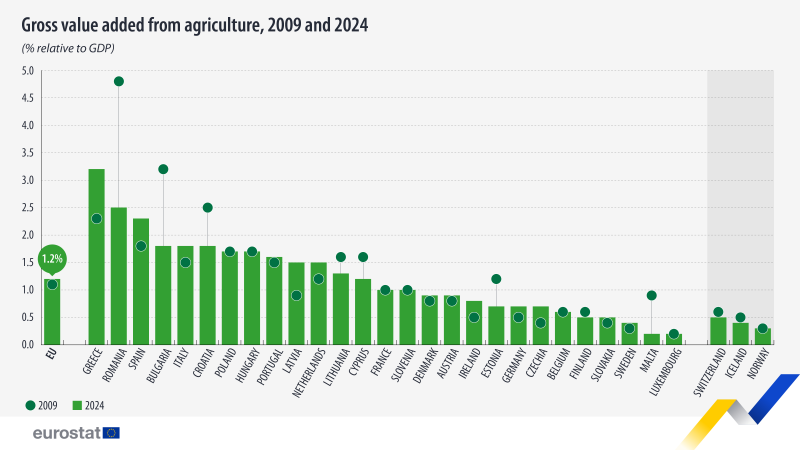
Greece stands out clearly at the top of the ranking, posting an agricultural value added share of 3.2% of GDP in 2024 - more than double the EU average. The chart places Greece at the high end of the 2024 bars, reflecting that farming and related activities remain a structurally significant part of the Greek economy. That kind of weight matters when sector-specific pressures hit, whether from weather, trade policy, or input costs.
At the other end of the spectrum, Luxembourg and Malta both came in at 0.2% of GDP in 2024, making agriculture nearly negligible in terms of economic output. The contrast with Greece is stark - a 16-fold difference between the highest and lowest-ranked countries within the same economic bloc. EU Research Spending: Sweden and Belgium Lead with 3.6% and 3.4% of GDP in 2024 shows a similar pattern of wide dispersion across member states, where small economies often punch well above average in knowledge-intensive sectors while staying minimal in traditional ones like farming.
The chart format - pairing 2024 bars with 2009 markers - frames the data as a structural snapshot rather than a trend story. But the 15-year gap between reference points does hint at how agricultural weight has shifted over time. For the EU as a whole, the 1.2% figure is modest, yet it masks real differences in how much farming underpins individual national economies. EUR/USD Gets a Nice Boost as Euro Area GDP Surprises at 0.6 offers broader context on EU economic performance, where sector composition plays into overall output readings. The Eurostat agriculture data adds one more layer to understanding why GDP figures can diverge sharply across member states even within a tightly integrated economic union.
 Saad Ullah