Marina Lyubimova

The market focused on the 15% tariff because it was the most visible outcome of the Turnberry agreement. It is probably not the most important one.
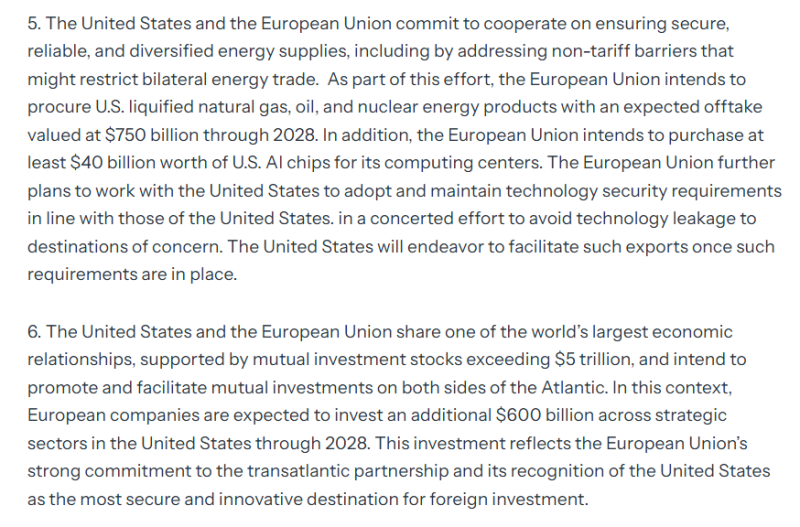
Buried inside the framework are commitments that reshape the economic balance of the deal. The European Union plans to purchase $750 billion worth of U.S. energy products through 2028, invest an additional $600 billion in the United States, and acquire at least $40 billion worth of American AI chips for computing centers.
Taken together, those commitments exceed $1.39 trillion.

The scale is difficult to ignore. The tariff determines the cost of moving goods across the Atlantic. The commitments determine where capital will flow. That distinction matters because capital, not tariffs, is increasingly what shapes industrial leadership.
The AI Clause Hidden Inside a Trade Deal
Among the agreement's provisions, one commitment stands out. The European Union intends to purchase at least $40 billion worth of U.S. AI chips for computing centers.
The figure is relatively small compared with the broader package, yet it may carry outsized strategic importance. European policymakers have discussed technological sovereignty, semiconductor independence, and building domestic AI capabilities. Yet one of the largest economic agreements between Washington and Brussels effectively locks in future demand for American compute infrastructure.
The beneficiaries are obvious. Nvidia, AMD, Broadcom, networking suppliers, server manufacturers, and the broader U.S. data-center ecosystem gain something that markets value highly: visibility into future demand. The agreement does not simply support U.S. AI exports. It reinforces America's position at the center of the global AI supply chain.
Why the Euro Reaction Was Telling
The reaction in currency markets offered another clue about how investors interpreted the agreement.
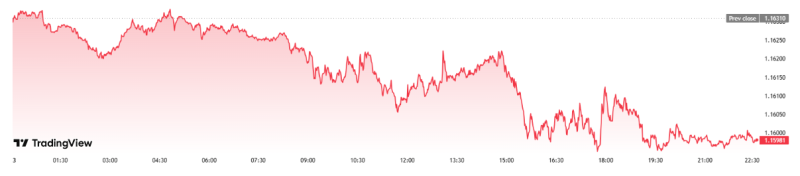
At first glance, the framework removes uncertainty for European exporters. That would normally be expected to support the euro. Instead, investors appeared more focused on where the money is going.
The agreement channels hundreds of billions of dollars toward American energy producers, American technology companies, and American assets. Every major financial commitment embedded in the framework ultimately increases demand for sectors where the United States already holds a competitive advantage.
The tariff may apply to European exports. The largest financial flows move in the opposite direction.
A Capital Allocation Agreement Disguised as a Trade Deal
Trade negotiations are usually judged by tariff rates. Turnberry may end up being judged by the investment commitments attached to them.
The agreement establishes a 15% cost for access to the U.S. market. At the same time, it secures commitments for energy purchases, technology procurement, and investment flows whose combined value approaches the scale of an entire year of transatlantic trade.
That is why the most important number in the agreement may not be 15%. It may be $1.39 trillion. Viewed from that perspective, Turnberry looks less like a traditional trade settlement and more like a framework that directs future European capital toward the industries driving America's next growth cycle - energy, data centers, and artificial intelligence.
 Marina Lyubimova