Saad Ullah

The US Dollar has gained ground against both developed and emerging market currencies in the wake of the latest geopolitical shock. But despite the scale of the event, the move looks underwhelming compared to previous episodes of global stress.
Dollar Climbs Past 102, But 2026 Gains Trail the 2022 Playbook
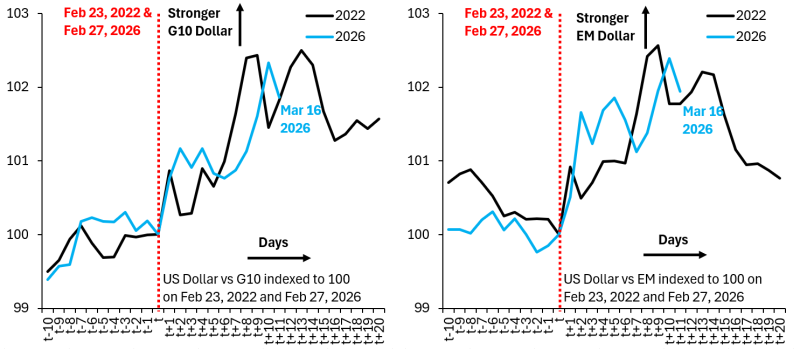
DXY, the widely tracked US Dollar Index, has risen against both G10 and EM currency baskets after the latest shock. Chart data rebased to 100 at the start of each event shows the dollar climbing above 102 against the G10 group within two weeks in both the February 2022 and February 2026 episodes. The 2026 path follows a similar direction, but early gains are noticeably smaller.
The dollar could return to a weaker trajectory once the conflict ends.
As analysts noted, the dollar appreciated after the shock but the move looks relatively muted given what happened. U.S. Dollar Index Holds 14-Year Uptrend Support outlines how structural support levels have repeatedly shaped the dollar's long-term trajectory.
EM Reaction Contained Despite a Larger Geopolitical Shock
Against emerging market currencies, the dollar also moved higher following the 2026 event, mirroring the directional response seen in 2022. However, the increase remained contained despite what analysts describe as a significantly larger geopolitical shock. DXY Price Analysis: Dollar Index Pulls Back from 99.50 as Support Levels Take Center Stage highlights the key resistance zones currently testing the index. The comparison points to a familiar pattern: the dollar tends to attract safe-haven flows during periods of global stress, but the size of the move depends heavily on how markets assess the duration and economic impact of the shock. DXY Reversal Watch: Dollar Eyes Liquidity Shift examines how turning points in the dollar can ripple through currency and risk asset markets more broadly.
The relatively modest rally suggests markets may already be looking past the immediate shock, pricing in a resolution rather than an escalation.
 Saad Ullah