Peter Smith

A fresh wave of consumer pessimism is pushing into record territory, reinforcing the idea that inflation is still deeply embedded in household psychology even after the worst of the post-pandemic price shock. As The Kobeissi Letter noted, the latest chart shows that more Americans now say higher prices have worsened their financial situation than at any point in the data series.
A Break Above Every Prior US Consumer Inflation Extreme
The chart supports the claim visually: the latest reading breaks above prior peaks, including the stress seen during 2008 and the inflation eras of the 1970s and 1980s. What makes the move stand out is not just the level but the way it has extended above the old ceiling.
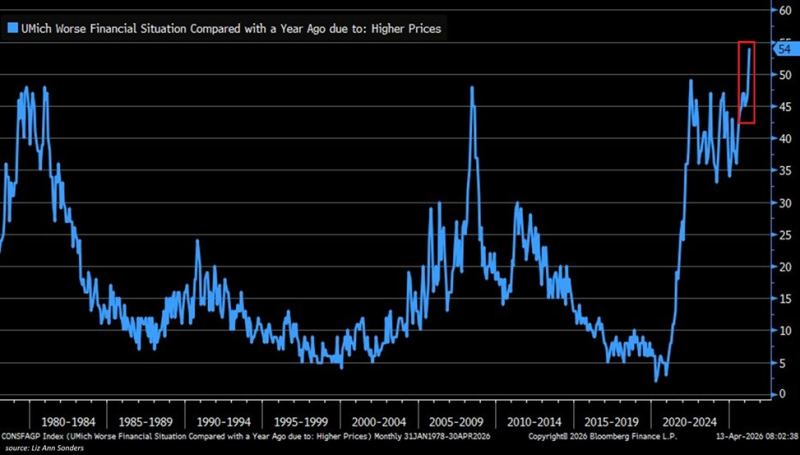
Earlier cycles produced sharp spikes and reversals - but the current surge has pushed into the mid-50s and held near those highs. That shifts the structure from a temporary flare-up to a broader deterioration in consumer mood that shows no sign of the self-correcting behavior seen in prior decades.
45% of Americans Blame High Prices for Financial Strain Despite Cooling Inflation captured an earlier stage of this trend when the reading was still below the current record - making the move from 45% to 54% a meaningful acceleration that occurred even as official inflation metrics were moderating.
The Post-2021 Consumer Pessimism Surge Never Truly Reset
The tweet says this measure has climbed roughly 900% since 2021, and the chart reflects that dramatic change in direction. After sitting near historical lows in the late 2010s, the series exploded higher in the post-2020 period, cooled only briefly, and then resumed climbing.
Instead of forming a durable top, the indicator kept making new highs. The latest move above the prior band around the mid-40s suggests that pessimism is no longer fading the way it did in earlier cycles - structurally, there is still no visible lower high or meaningful breakdown in the trend.
Inflation Expectations Are Climbing With US Consumer Sentiment
The tweet also notes that consumers now expect inflation to rise 4.8% over the next year - the highest reading since June 2025. That matters because the chart is not measuring official CPI directly. It is measuring lived financial stress tied to prices, which often has a stronger effect on sentiment and behavior than headline inflation data alone.
Consumers expect 4.8% inflation over the next year - they are not behaving as if inflation has disappeared, and that expectation shapes spending and saving decisions regardless of what official CPI prints.
Inflation Price Expectations Rise Again: Conference Board Data Signals Consumer Worries reinforces the expectations dimension of the current reading, showing how forward-looking inflation anxiety has been building alongside the retrospective financial strain measure the chart is now tracking at record levels.
U.S. Consumer Inflation Fears Despite Fed Rate Cut Plans adds the policy context - showing that even the prospect of Fed easing has not been sufficient to shift consumer inflation psychology, which helps explain why the pessimism reading continues to make new highs despite changing market expectations around rates.
The picture is straightforward: consumers are not behaving as if inflation has disappeared. The chart shows record dissatisfaction tied to higher prices, and the expectations data suggests households still see more pressure ahead rather than relief.
 Peter Smith